Loading…
Sec 2 · G3 (Express)
Direct and inverse proportion
Practise direct and inverse proportion with step-by-step help. Free account.
1. Direct proportion
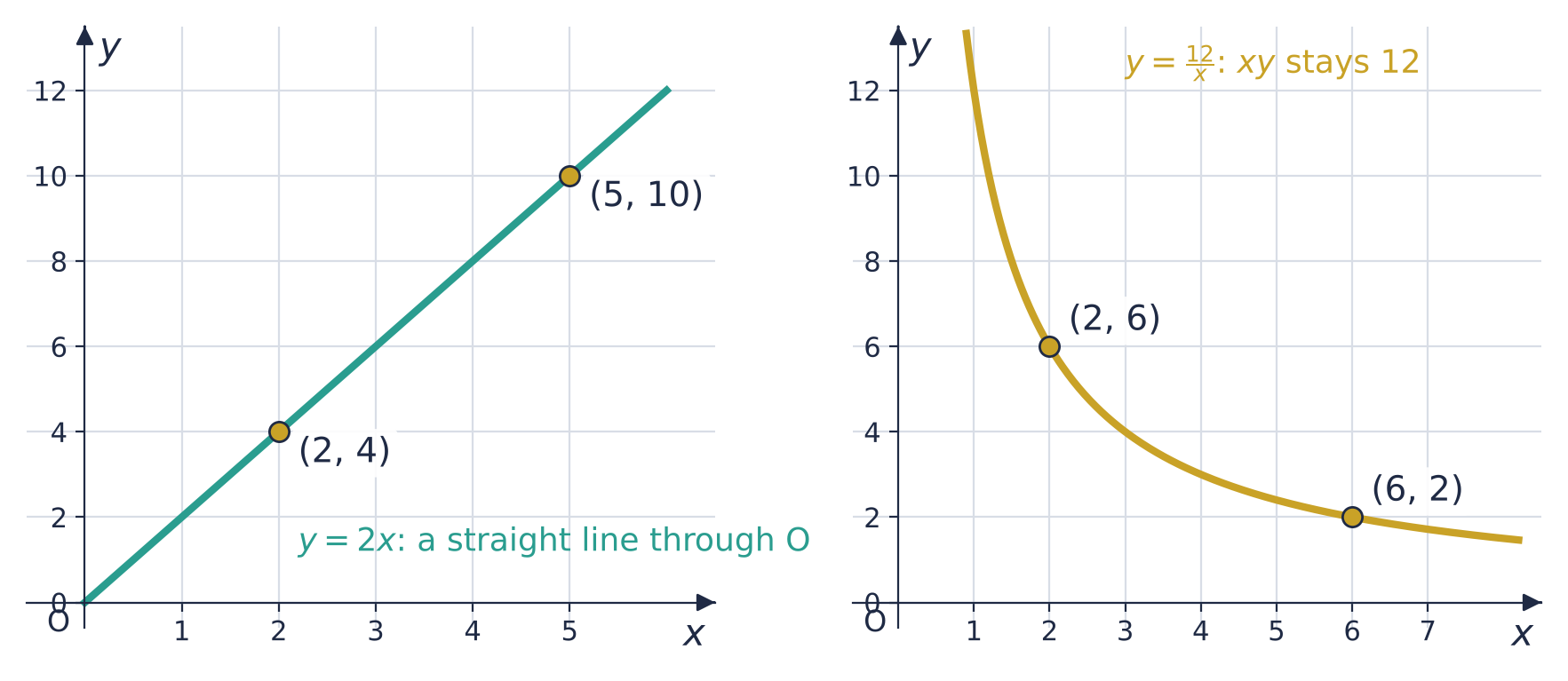
| Words | Equation |
|---|---|
| is directly proportional to | |
| is directly proportional to | |
| is directly proportional to | |
| is directly proportional to |
y = 12 when x = 4: find k first
e.g.
- so ; when ,
y is proportional to x², and y = 18 when x = 3
e.g.
- when : , which is
📖 Worked example
is directly proportional to . When , . Find the value of when .
Step 1 of 3
Write the equation connecting y and x, with a constant k
📖 Worked example
is directly proportional to the cube of . Given that when , express in terms of .
Step 1 of 3
Write the equation connecting y and x, with a constant k
📖 Worked example
The graph of against is a straight line through the points and . Is directly proportional to ?
Step 1 of 2
Work out y ÷ x at each point
At : .At : .
📖 Worked example
The extension of a spring is directly proportional to the mass hung on it. A mass of 200 g stretches the spring by 3 cm. Find the extension, in millimetres, when a mass of 1.5 kg is hung on it.
Step 1 of 3
Change 1.5 kg to g, the unit in the pair given
kg g
📖 Worked example
is directly proportional to the square of . When increases from to , increases by . Find the value of when .
Step 1 of 4
Write the equation with a constant k
2. Inverse proportion
| Words | Equation |
|---|---|
| is inversely proportional to | |
| is inversely proportional to |
y = 6 when x = 4
e.g.
- when : , which is
Workers and days: 6 workers take 10 days
e.g.
- workers take days
📖 Worked example
10 workers take 25 days to paint a block of flats. Find the number of days 5 workers would take, working at the same rate.
Step 1 of 2
Find how long ONE worker would take
days
📖 Worked example
6 machines, running 5 hours a day, take 16 days to make an order of bottles. Find the number of days 12 machines, running 10 hours a day, would take to make the same order.
Step 1 of 2
The whole job in machine-hours: machines × hours a day × days
machine-hours
📖 Worked example
A farmer has enough feed to last 14 cows for 10 days. After 7 days, the farmer sells 7 of the cows. Assuming that every cow eats the same amount each day, find the number of days the remaining feed will last.
Step 1 of 3
The assumption behind the method
We assume that every cow eats the same amount each day.
3. Map scales
| Scale | Length | Area |
|---|---|---|
1 : 50 000, a 7.4 cm road on the map
e.g.
- km on the ground
📖 Worked example
A map is drawn to a scale of . Two towns are cm apart on the map. Find the actual distance, in kilometres, between the two towns.
Step 1 of 2
Write the scale as a ratio with units (1 km = 100 000 cm)
📖 Worked example
A map is drawn to a scale of . A park has an area of cm² on the map. Find the actual area of the park, in km².
Step 1 of 3
Write the scale as a ratio with units (1 km = 100 000 cm)
📖 Worked example
A map is drawn to a scale of . On the map, the route from a school to a sports centre is cm long. A cyclist leaves the school at and must reach the sports centre at . Find the average speed, in km/h, at which the cyclist must travel.
Step 1 of 4
Write the scale as a ratio with units (1 km = 100 000 cm)
Try a question: Direct and inverse proportion
Free · no sign-upAnswer a real practice question. Get it wrong and MugCorner shows you where it went wrong, with hints and a step-by-step guide.
Practise direct and inverse proportion with step-by-step help
Endless questions from basic to exam level. Get one wrong and see where it went wrong. Free account.