Loading…
Sec 2 · G2 (N(A))
Quadrilaterals and polygons
Practise quadrilaterals and polygons with step-by-step help. Free account.
1. Quadrilaterals
| Quadrilateral | Sides | Angles | Diagonals |
|---|---|---|---|
| parallelogram | opposite sides parallel and equal | opposite angles equal | bisect each other |
| rectangle | opposite sides parallel and equal | all | equal, bisect each other |
| rhombus | all equal | opposite angles equal | bisect each other at |
| square | all equal | all | equal, bisect each other at |
| trapezium | one pair parallel | ||
| isosceles trapezium | one pair parallel; the other two sides equal | base angles equal | equal |
| kite | two pairs of equal adjacent sides | one pair equal | cross at ; one bisects the other |
📖 Worked example
is a parallelogram. Find .
Step 1 of 2
Which angle fact gives x?
(int. ∠s, )
| Angles in a ratio | Share | Example |
|---|---|---|
| : units , unit | ||
| parallelogram, | (int. s) | : unit |
2. Polygons
| sides | Formula | Example: hexagon, |
|---|---|---|
| sum of interior angles | ||
| sum of exterior angles | ||
| each exterior angle (regular) | ||
| each interior angle (regular) |
Number of sides of a regular polygon with interior angle 156°
e.g.
📖 Worked example
The diagram shows a regular nonagon. Find .
Step 1 of 2
Sum of the interior angles of a nonagon
📖 Worked example
Each interior angle of a regular polygon is times each of its exterior angles. Find the number of sides of the polygon.
Step 1 of 3
An interior angle and its exterior angle make a straight line: together 180°
units unit
📖 Worked example
In the diagram, a square, a regular pentagon and a regular polygon with sides fit together round the point , with no gaps. Find .
Step 1 of 3
Each interior angle of the two known polygons: (n − 2) × 180° ÷ n
Square: Regular pentagon:
📖 Worked example
A polygon has sides. 3 of its interior angles are , and . Each of the other interior angles is . Find .
Step 1 of 3
Work with exterior angles (180° − each interior angle): they add up to 360°
Exterior angles of the given ones: , , Their sum
📖 Worked example
The diagram shows a regular hexagon with the diagonal . Find .
Step 1 of 2
Each interior angle of the regular polygon
3. Special quadrilaterals
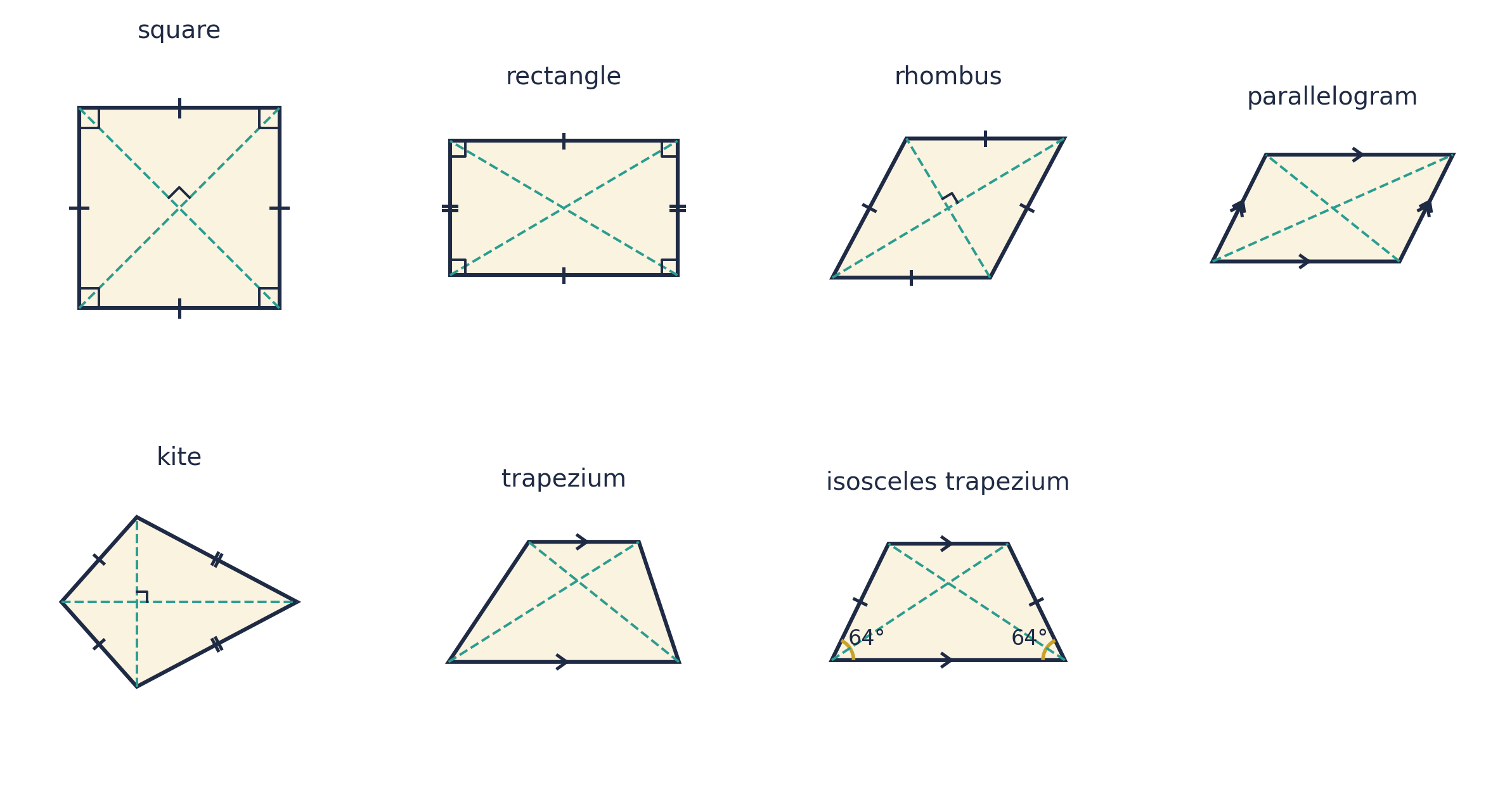
| Property | square | rectangle | rhombus | parallelogram | kite | trapezium | isosceles trapezium |
|---|---|---|---|---|---|---|---|
| all sides equal | ✓ | ✗ | ✓ | ✗ | ✗ | ✗ | ✗ |
| both pairs of opposite sides parallel | ✓ | ✓ | ✓ | ✓ | ✗ | ✗ | ✗ |
| only one pair of parallel sides | ✗ | ✗ | ✗ | ✗ | ✗ | ✓ | ✓ |
| all angles | ✓ | ✓ | ✗ | ✗ | ✗ | ✗ | ✗ |
| opposite angles equal | ✓ | ✓ | ✓ | ✓ | ✗ | ✗ | ✗ |
| diagonals bisect each other | ✓ | ✓ | ✓ | ✓ | ✗ | ✗ | ✗ |
| diagonals equal | ✓ | ✓ | ✗ | ✗ | ✗ | ✗ | ✓ |
| diagonals cross at | ✓ | ✗ | ✓ | ✗ | ✓ | ✗ | ✗ |
| diagonals bisect the angles | ✓ | ✗ | ✓ | ✗ | ✗ | ✗ | ✗ |
📖 Worked example
The marks on the diagram show what is known about quadrilateral . Write down the most special name of .
Step 1 of 4
Equal sides (the ticks)
Equal sides: all four.
📖 Worked example
is a rhombus. Its diagonals meet at . cm and cm. Find .
Step 1 of 2
The diagonals of a rhombus bisect each other at right angles
cm, cm
📖 Worked example
is a rectangle. Its diagonals meet at , and . Find .
Step 1 of 2
Find ∠OBA and give the reason
(base ∠s of isos. △)
| The angles show | Sides not all equal | Four equal sides |
|---|---|---|
| all four angles | rectangle | square |
| both pairs of opposite angles equal | parallelogram | rhombus |
| only () | trapezium |
4. Line symmetry
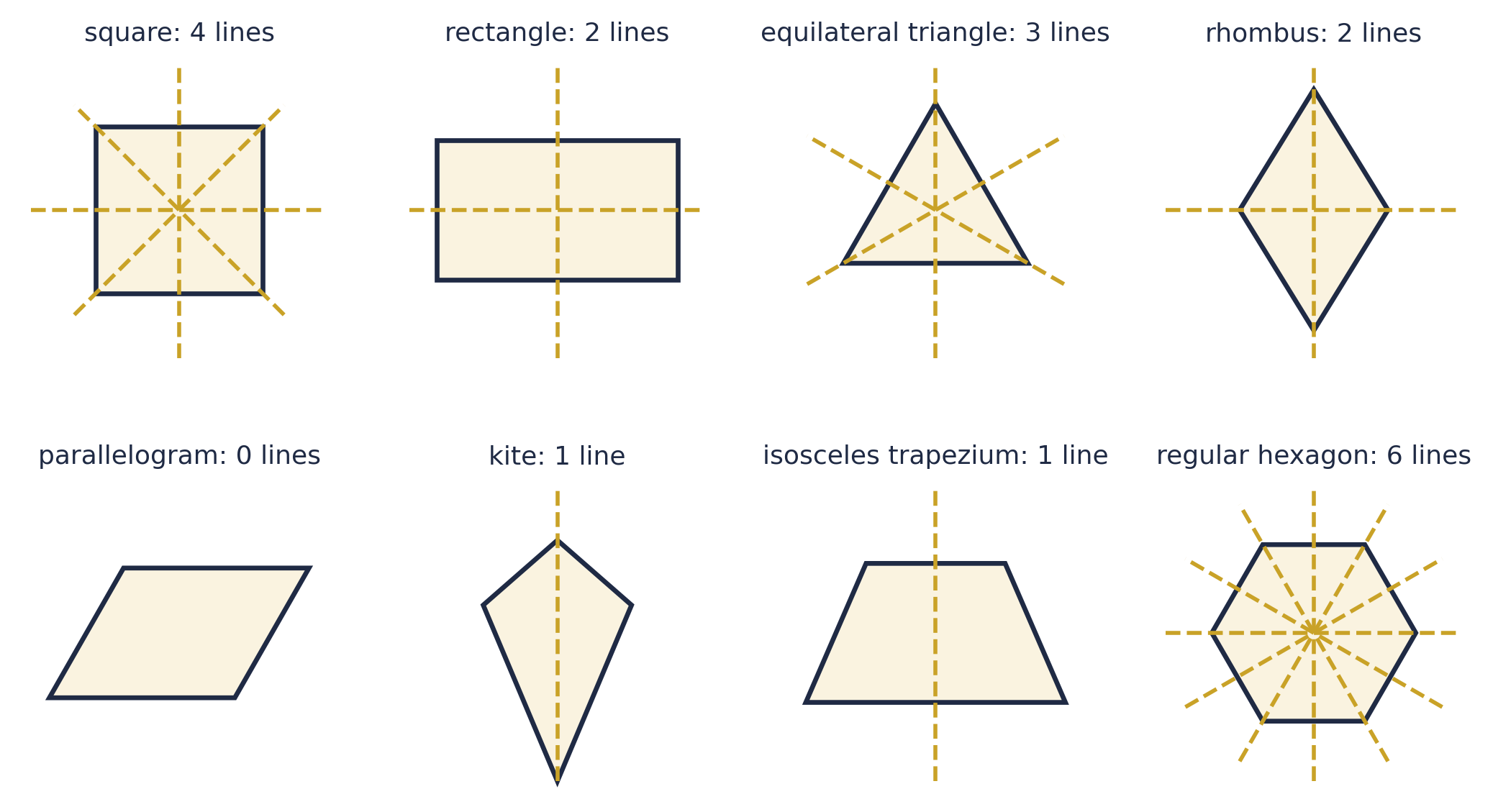
| Word | Meaning |
|---|---|
| line of symmetry | a fold line: the two halves match exactly |
| regular polygon, sides | lines of symmetry |
📖 Worked example
The diagram shows a kite. State whether the dashed line is a line of symmetry of the shape.
Step 1 of 2
Imagine folding the shape along the dashed line
Each corner on one side must land exactly on a corner on the other side, and each side on a side.
📖 Worked example
The diagram shows a rectangle. Write down the number of lines of symmetry of the shape.
Step 1 of 2
Look for every fold line that makes the two halves match
Lines of symmetry: the two lines joining the middles of opposite sides (not the diagonals).
5. Rotational symmetry
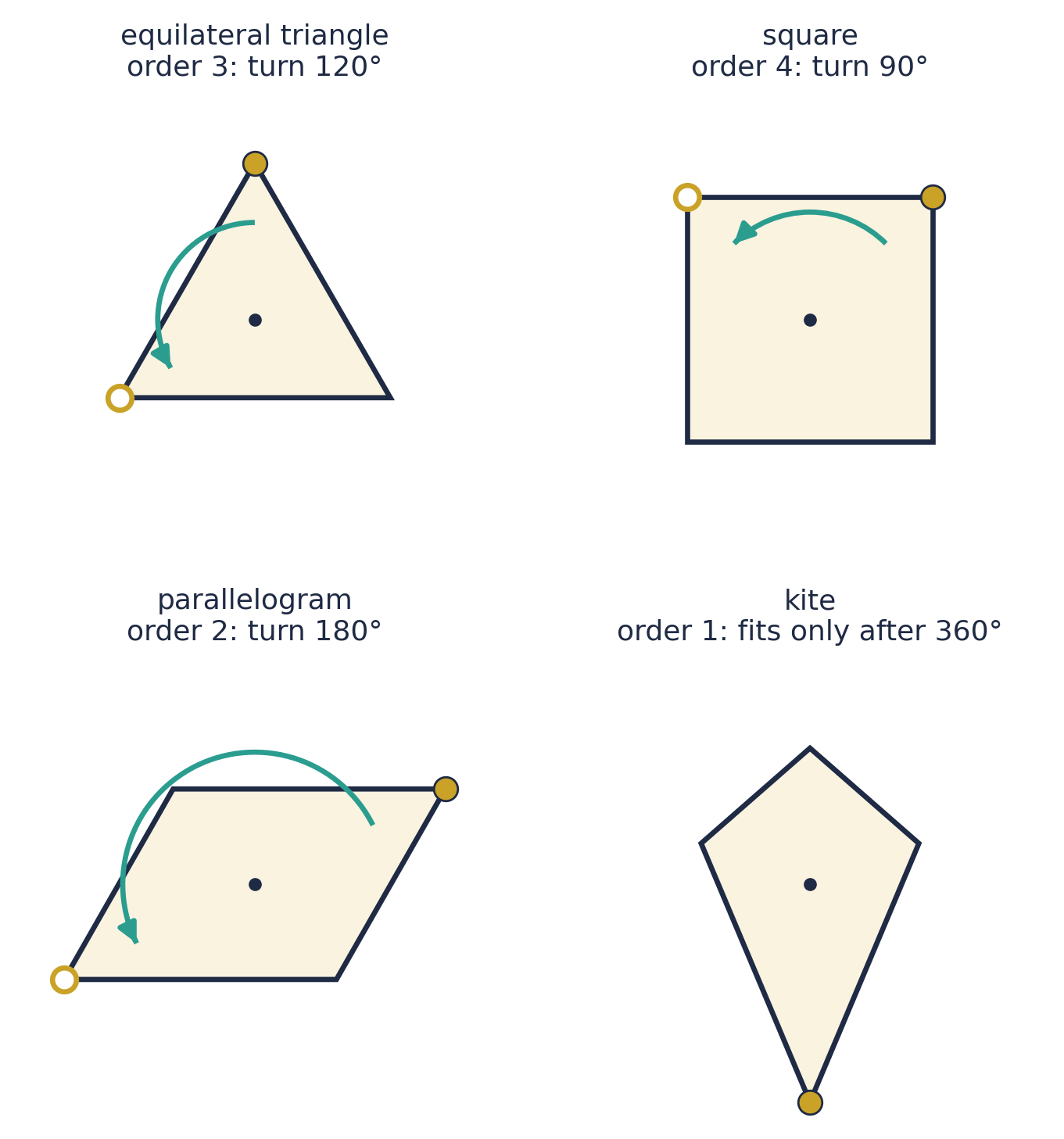
Order: how many times it fits in one full turn
e.g.
- a square: order
| Shape | Lines of symmetry | Order | Angle of rotation |
|---|---|---|---|
| square | |||
| rectangle | |||
| equilateral triangle | |||
| rhombus | |||
| parallelogram | |||
| kite | |||
| regular hexagon |
📖 Worked example
The diagram shows a propeller shape. Write down its order of rotational symmetry.
Step 1 of 1
Turn the shape about its centre: in one full turn, how many times does it look exactly the same?
It looks the same every third of a turn.
📖 Worked example
The diagram shows an equilateral triangle. Find the smallest angle through which it can be rotated about its centre to look exactly the same.
Step 1 of 2
Turn the shape about its centre: in one full turn, how many times does it look exactly the same?
It looks the same every third of a turn.
Practise quadrilaterals and polygons with step-by-step help
Endless questions from basic to exam level. Get one wrong and see where it went wrong. Free account.