Loading…
Sec 1 · G3 (Express)
Ratio, rate and speed
Practise ratio, rate and speed with step-by-step help. Free account.
1. Ratio
| Rule | Example |
|---|---|
| divide by the HCF | |
| same units first | is , so |
| fractions: multiply by the LCM of the denominators | |
| three quantities | and give |
Share 64 in the ratio 3 : 5: find 1 unit first
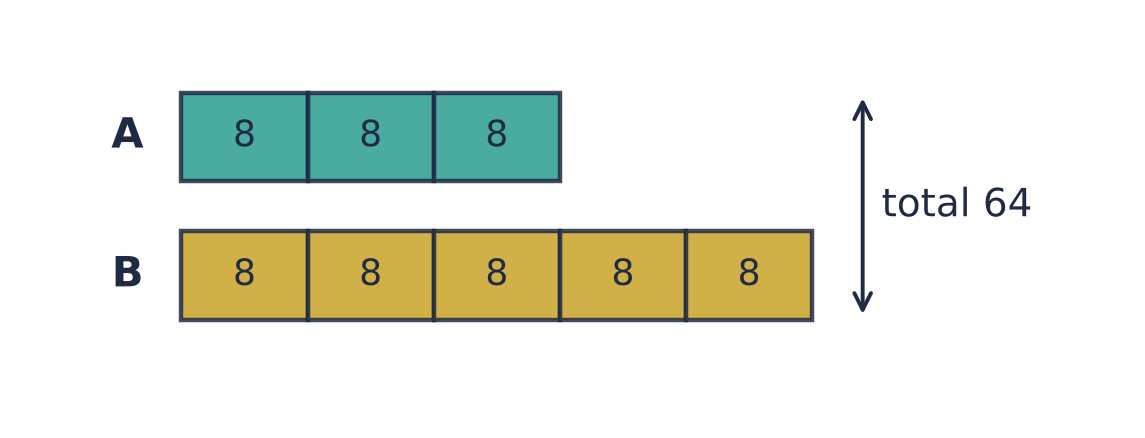
e.g.
- A: , which is
- B: , which is
📖 Worked example
Express the ratio g kg in its simplest form.
Step 1 of 2
Change both quantities to the same (smaller) unit first
📖 Worked example
Siti and Devi share 96 stamps in the ratio . Find the number of stamps Devi gets.
Step 1 of 3
Count the total number of units
📖 Worked example
The ratio of the number of red marbles to the number of blue marbles is . After 10 more blue marbles are put into the bag, the ratio becomes . Find the number of blue marbles now.
Step 1 of 4
The number of red marbles does not change: make its units the same in both ratios (LCM)
📖 Worked example
Of the fruits in a basket, are mangoes. The rest are apples and oranges in the ratio . There are 8 oranges. Find the number of mangoes.
Step 1 of 4
The rest is what is left of the whole: 1 − 1/3
📖 Worked example
Siti, Devi and Kumar share $840. The ratio of Siti's share to the total of Devi's and Kumar's shares is . Devi receives $90 less than Kumar. Find the amount Devi receives.
Step 1 of 2
Devi and Kumar together have 3 of the 5 units (in dollars)
📖 Worked example
The aspect ratio of a rectangle is width : height. A video with an aspect ratio of is shown on a screen with an aspect ratio of . It is made as large as possible without being cut off, so it fills the full height of the screen, as shown in the diagram. Find the fraction of the screen that is not covered.
Step 1 of 3
Both have the same height: make the heights the same number of units (LCM of the second terms)
2. Rate
| Rate | Example |
|---|---|
| per unit | $4.50 for 3 kg is $1.50 per kg |
| printing | pages in minutes is pages per minute |
📖 Worked example
A printer prints 270 pages in 9 minutes. Find its printing rate, in pages per minute.
Step 1 of 1
Find the rate: multiply or divide?
The rate is pages per minute.
3. Speed
| Find | Formula |
|---|---|
| speed | |
| distance | speed time |
| time | |
| average speed |
Kilometres per hour to metres per second: × 1000, then ÷ 3600
e.g.
- m/s
Average speed: 60 km in 1.5 h, then 40 km in 0.5 h
e.g.
- km/h, not the mean of and
📖 Worked example
A train travels 120 km at a constant speed of 50 km/h. Find the time taken. Give your answer in hours and minutes.
Step 1 of 2
Find the time in hours: multiply or divide?
📖 Worked example
A car travels from A to B and then from B to C, as shown in the diagram. The journey from A to B takes 2 hours and the journey from B to C takes 1 hour. Find the average speed for the whole journey, in km/h.
Step 1 of 3
Total distance
📖 Worked example
A train 150 m long travels at a constant speed of 54 km/h. It takes 30 seconds to pass completely over a bridge, from the moment its front reaches the bridge to the moment its back leaves it. Find the length of the bridge, in metres.
Step 1 of 3
Change the speed to metres per second (÷ 3.6)
📖 Worked example
A bicycle travels at a constant speed of 30 km/h. Each of its wheels has a diameter of 70 cm and turns without slipping. Find the number of complete turns (revolutions) each wheel makes in one minute, correct to the nearest whole number.
Step 1 of 3
The distance travelled in one minute, in cm (1 km = 100 000 cm, 1 h = 60 min)
4. Distance–time graphs
| On the graph | Means | Example |
|---|---|---|
| gradient | speed | km in min: km/h |
| flat stage | stopped | from to min: a -minute stop |
| steeper | faster | km/h is steeper than km/h |
| going down | travelling back towards the start | back at : home again |
| average speed | , stops included | km/h |
📖 Worked example
The distance–time graph shows Ravi's cycle ride from home. Find Ravi's speed from A to B, in km/h.
Step 1 of 3
Read the distances at A and B: the distance travelled (the rise)
📖 Worked example
The distance–time graph shows Nur's drive from Town P. Find Nur's average speed for the whole journey, in km/h.
Step 1 of 3
Total distance travelled
The journey ends km from Town P.
5. Utilities and bills
| Bill | Charged for | How |
|---|---|---|
| electricity | kWh used | current reading previous reading, the rate |
| water | m³ used, in tiers | the first part at the lower rate, the rest at the higher rate |
| mobile phone | minutes over the free time | monthly fee extra minutes the rate |
Electricity: units used
e.g.
- at cents per kWh: is cents, which is $134.75
Water: 45 m³, the first 30 m³ at $1.20, the rest at $1.60
e.g.
📖 Worked example
The table shows a household's electricity meter readings for a month and the rate charged. Find the cost of the electricity used, in dollars.
| Previous meter reading | Current meter reading | Rate |
|---|---|---|
| 12460 kWh | 12828 kWh | 30 cents per kWh |
Step 1 of 3
Units used = current reading − previous reading
📖 Worked example
Mei Ling's mobile phone plan is shown in the table. In March, Mei Ling made 380 minutes of calls. Find the amount of Mei Ling's bill for March.
| Monthly fee | Free talk time | Extra calls |
|---|---|---|
| $20 | 300 min | 10 cents per min |
Step 1 of 3
Extra minutes = minutes used − free minutes
6. Currency exchange
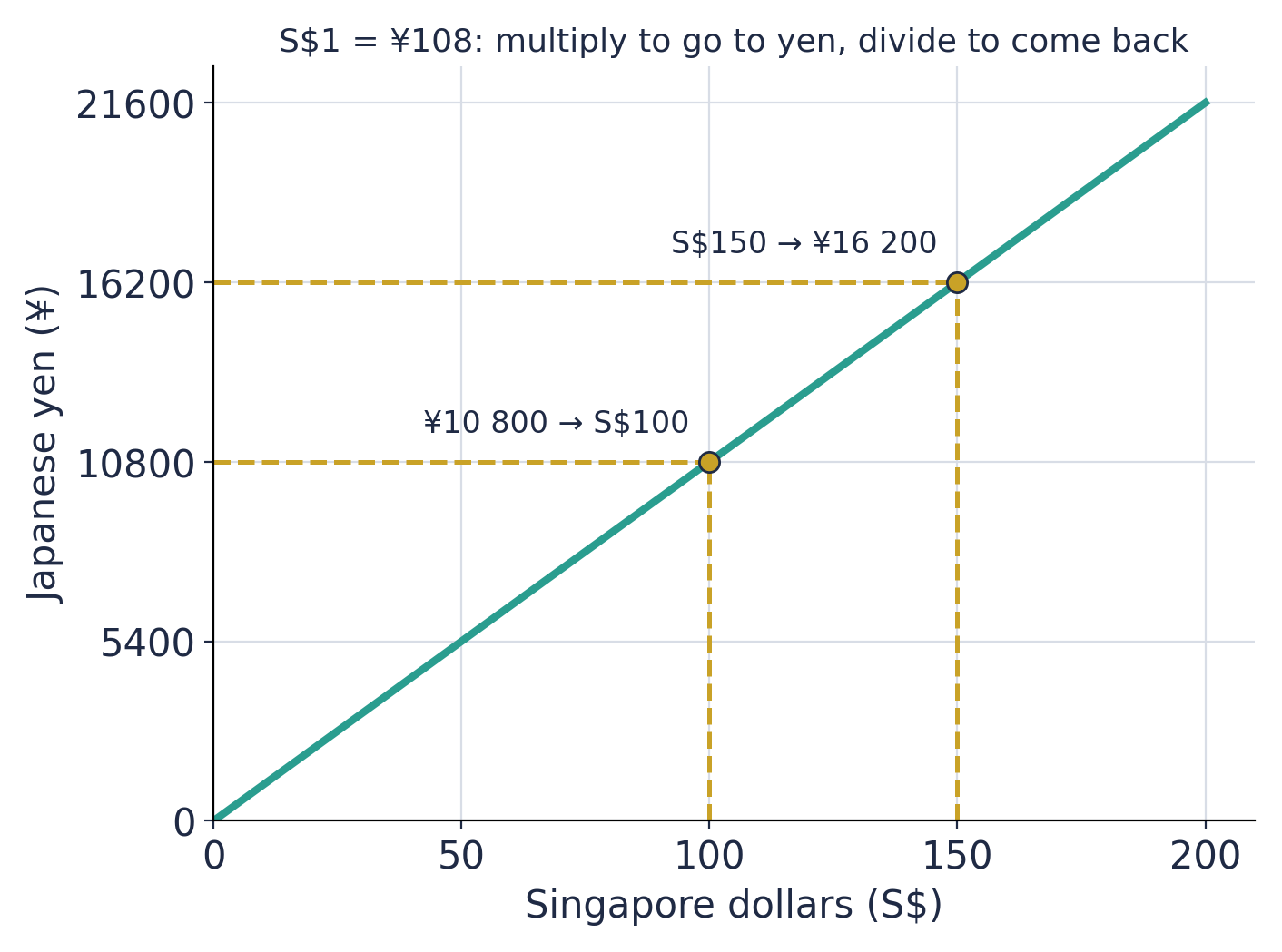
| Rate | S$ to the foreign currency | Back to S$ |
|---|---|---|
| S$1 buys ¥108 | multiply by | divide by |
| 1 ringgit costs S$0.30 | divide by | multiply by |
S$200 into yen
e.g.
- ¥
¥16 956 back into Singapore dollars
e.g.
- S$157
📖 Worked example
The table shows a money changer's exchange rates. Devi changes S$800 into Malaysian ringgit. Find the amount, in Malaysian ringgit, that Devi receives. Give your answer correct to 2 decimal places where necessary.
| Currency | S$1 buys |
|---|---|
| Malaysian ringgit (RM) | 3.4 |
| Japanese yen (¥) | 108 |
| Australian dollars (A$) | 1.2 |
Step 1 of 1
Use the exchange rate: multiply or divide?
Devi receives RM 2720.
📖 Worked example
Siti wants to change S$1000 into Malaysian ringgit. The rates at two money changers are shown in the table. Which money changer gives Siti more Malaysian ringgit?
| Money changer | Rate |
|---|---|
| A | S$1 = RM 3.4 |
| B | S$100 = RM 346.8 |
Step 1 of 3
Money changer A: the amount of Malaysian ringgit received
📖 Worked example
On a certain day, S$1 RM 3.4 and S$1 US$0.75. Devi changes RM 100 into US dollars, through Singapore dollars. Find the amount, in US dollars, that Devi receives, correct to 2 decimal places.
Step 1 of 2
RM into Singapore dollars: divide by 3.4 (keep the full value)
📖 Worked example
Before a holiday, Ben changes S$500 into Malaysian ringgit when S$1 RM 3.45. Ben spends RM 1,210 on the holiday. After the holiday, Ben changes the rest back into Singapore dollars when S$1 RM 3.56. Find the amount, in Singapore dollars, that Ben receives, correct to the nearest cent.
Step 1 of 3
Into Malaysian ringgit at the first rate: multiply
📖 Worked example
A tablet costs S$189 in Singapore. The same tablet costs RM 614 overseas, where S$1 RM 3.42. Where is it cheaper? Show your working.
Step 1 of 2
Change the overseas price into Singapore dollars: divide by the rate
(to the nearest cent)
📖 Worked example
A camera costs S$250 in Singapore. Overseas, the same camera costs A$270, which is 10% cheaper than the price in Singapore. Find the exchange rate, giving your answer in the form S$1 A$.
Step 1 of 2
The overseas price is worth (100% − p%) of the Singapore price (in dollars)
Try a question: Ratio, rate and speed
Free · no sign-upAnswer a real practice question. Get it wrong and MugCorner shows you where it went wrong, with hints and a step-by-step guide.
Practise ratio, rate and speed with step-by-step help
Endless questions from basic to exam level. Get one wrong and see where it went wrong. Free account.