Loading…
Sec 3 E-Math Quadratic equations worksheet with answers
A free Sec 3 E-Math worksheet on quadratic equations: 8 questions, 30 marks, short questions first and then structured ones, in the school exam style. The answers and full worked solutions are on the last page.
In the print window, choose Save as PDF to download it.
Need the formulas first? Read the Quadratic equations notes. Or practise it online with step-by-step help when you get one wrong.
Try a question: Quadratic equations
Free · no sign-upAnswer a real practice question. Get it wrong and MugCorner shows you where it went wrong, with hints and a step-by-step guide.
Free account
What you get when you sign in
Everything on this page stays free. An account is where quadratic equations practice starts adding up.
- Endless questions on every chapter, at every level
- Your mistakes tracked by type, so you see what keeps costing marks
- Revision reminders before a topic fades
Start freeFree account. No card. Takes a minute.
Compare browsing and a free account
| Browsing | Account | |
|---|---|---|
| Read the notes and print worksheets and papers | ✓ | ✓ |
| Try a question with marking, hints and the step guide | ✓ | ✓ |
| Endless questions on every chapter, at every level | – | ✓ |
| Levels that unlock as you improve | – | ✓ |
| Your mistakes tracked by type, so you see what keeps costing marks | – | ✓ |
| WA practice papers on the chapters being tested | – | ✓ |
| Revision reminders before a topic fades | – | ✓ |
| Progress page and leaderboards | – | ✓ |
MugCornerT-Leng Tuition · mugcornersg.com
Sec 3 E-Math worksheet: Quadratic equations
Total: 30 marksSuggested time: 45 minutes
Name: ______________________________Class: ____________ Date: ____________
Answer all questions. Show all your working.
If the degree of accuracy is not specified in the question, and if the answer is not exact, give the answer to three significant figures. Give answers in degrees to one decimal place. For π, use either your calculator value or 3.142, unless the question requires the answer in terms of π.
Section A
1
Find the coordinates of the point where the curve crosses the -axis.
Answer[2]
2
The graph of has its vertex at and passes through , as shown. Find the value of , and write down the equation of the graph.
Answer[3]
3
A positive integer is multiplied by one more than twice itself. The result is . Let the integer be . Find the integer.
Answer[3]
4
Solve , giving your answers correct to 2 decimal places.
Answer[3]
Section B
5
(a)Factorise .
Answer (a)[2]
(b)Hence solve the equation .
Answer (b)[1]
6
Solve the equation .
Answer[4]
7
A ball is thrown upwards. Its height, metres, above the ground seconds after it is thrown is given by .
(a)Find the height of the ball after seconds.
Answer (a)m[1]
(b)Find the values of when the ball is m above the ground.
Answer (b)[3]
(c)Explain why there are two answers to part (b).
[1]
8
A rectangular garden is m long and m wide. The area of the garden is m².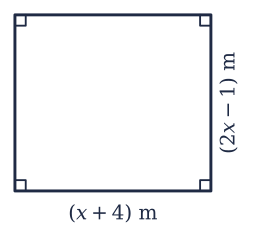
(a)Show that .
[2]
(b)Solve , giving your answers correct to 2 decimal places.
Answer (b)[3]
(c)Hence find the perimeter of the garden, giving your answer correct to 3 significant figures.
Answer (c)m[2]
END OF PAPER
Answers and worked solutions
Question 1
Answer: The curve crosses the -axis at .[2]
On the -axis, .The curve crosses the -axis at .
Question 2
Answer: [3]
Question 3
Answer: The integer [3]
or or is rejected because x must be a positive integer. So .The integer
Question 4
Answer: or (2 d.p.)[3]
or or (2 d.p.)
Question 5
(a)Answer: [2]
(b)Answer: or [1]
or
Question 6
Answer: or [4]
(divide by ) or
Question 7
(a)Answer: m[1]
m
(b)Answer: or [3]
or
(c)[1]
The ball is at m on the way up, after s, and again on the way down, after s.
Question 8
(a)[2]
(shown)
(b)Answer: or [3]
or or (2 d.p.)
(c)Answer: m[2]
is rejected because a length can't be negative.Perimeter m (3 s.f.)