Loading…
Sec 3 A-Math · Coordinate geometry
Perpendicular lines questions with answers
Practice questions on perpendicular lines, from the basics up to exam level, each with a full worked solution. Try one online now, or work through the list below on paper and open the solution to check your working.
Try a question: Perpendicular lines
Free · no sign-upAnswer a real practice question. Get it wrong and MugCorner shows you where it went wrong, with hints and a step-by-step guide.
Key facts: Parallel and perpendicular lines
line through
- Formula
- Example
parallel
- Formula
- Example
- and
perpendicular
- Formula
- Example
| Name | Formula | Example |
|---|---|---|
| line through | ||
| parallel | and | |
| perpendicular |
Why m₁m₂ = −1: turn the gradient triangle through 90°
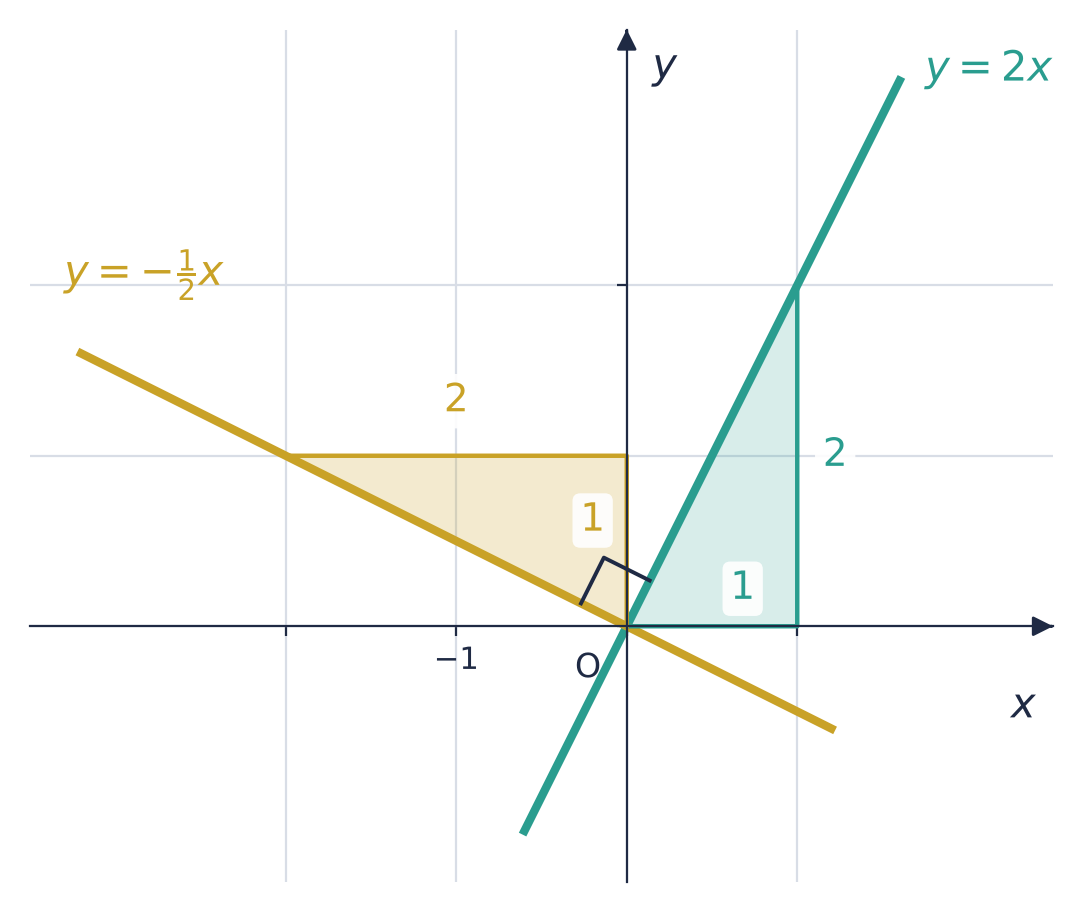
- : across , up , gradient
- Turn that triangle through : up , across , gradient
- The two numbers swap and one changes sign, so the gradients multiply to
Perpendicular bisector of AB: through M, perpendicular to AB
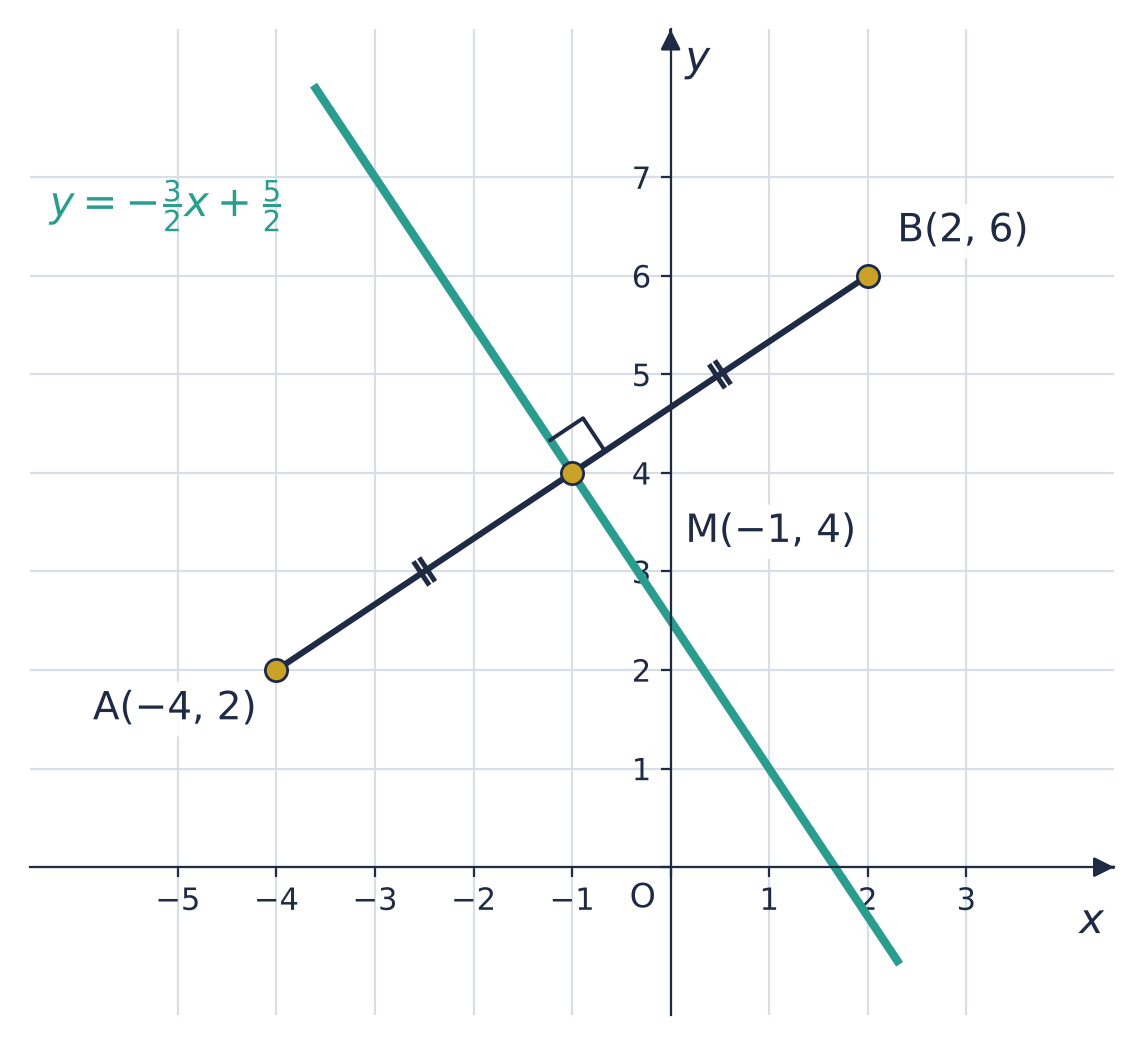
e.g.
- , so the perpendicular gradient is
Worked example
Find the gradient of a line perpendicular to the line .
Step 1 of 2
Make y the subject to read the gradient: y = mx + c
Free account
What you get when you sign in
Everything on this page stays free. An account is where perpendicular lines practice starts adding up.
- Endless questions on every chapter, at every level
- Your mistakes tracked by type, so you see what keeps costing marks
- Revision reminders before a topic fades
Start freeFree account. No card. Takes a minute.
Compare browsing and a free account
| Browsing | Account | |
|---|---|---|
| Read the notes and print worksheets and papers | ✓ | ✓ |
| Try a question with marking, hints and the step guide | ✓ | ✓ |
| Endless questions on every chapter, at every level | – | ✓ |
| Levels that unlock as you improve | – | ✓ |
| Your mistakes tracked by type, so you see what keeps costing marks | – | ✓ |
| WA practice papers on the chapters being tested | – | ✓ |
| Revision reminders before a topic fades | – | ✓ |
| Progress page and leaderboards | – | ✓ |
Questions
- Question 1Perpendicular gradient
Find the gradient of a line perpendicular to the line .
Show the worked solution
- Step 1: Make y the subject to read the gradient: y = mx + c
- Step 2: Perpendicular gradients multiply to −1, so divide −1 by the gradient (flip it and change its sign), so
- Question 2Line through a point
Find the equation of the line which passes through the point and is perpendicular to the line .
Show the worked solution
- Step 1: Make y the subject to read the gradient: y = mx + c
- Step 2: Perpendicular gradients multiply to −1, so divide −1 by the gradient (flip it and change its sign), so
- Step 3: Through (-1, -2): y − y₁ = m(x − x₁), then make y the subject
- Question 3Perpendicular bisector
Find the equation of the perpendicular bisector of the line joining and .
Show the worked solution
- Step 1: It passes through the mid-point of AB: put A and B into the mid-point formula
- Step 2: It is perpendicular to AB: m₁ × m₂ = −1. Put the coordinates into the gradient formula
- Step 3: y − y₁ = m(x − x₁) through the mid-point, then make y the subject
- Question 4The equation of a line: y − y₁ = m(x − x₁)
Find the equation of the line which has gradient and passes through the point .
Show the worked solution
- Step 1: Put the point and the gradient into y − y₁ = m(x − x₁)
- Step 2: Expand, then make y the subject
- Question 5Is it a right angle?
The points , and are the vertices of a triangle. Determine whether angle is a right angle.
Show the worked solution
- Step 1: Angle ABC is between BA and BC. The gradient of BA: put the coordinates into the gradient formula
- Step 2: The gradient of BC: put the coordinates into the gradient formula
- Step 3: Perpendicular gradients multiply to −1: multiply the two gradientsThe product is , so is perpendicular to : angle is .
- Question 6Where the perpendicular from a point meets a line
The perpendicular from the point to the line meets the line at . Find the length of , leaving your answer in surd form.
Show the worked solution
- Step 1: Read the gradient of the line: y = mx + c
- Step 2: Perpendicular gradients multiply to −1, so divide −1 by the gradient (flip it and change its sign), so
- Step 3: The perpendicular through P: y − y₁ = m(x − x₁), then make y the subject
- Step 4: N is where the two lines meet: make the y's equal, then multiply every term by 2 to clear the fractions
- Step 5: Solve for x, then find y is .
- Step 6: PN² = (x₂ − x₁)² + (y₂ − y₁)²
- Step 7: Square-root, in simplest surd form