Loading…
Sec 3 A-Math · Exponential and logarithmic functions
Exponential models questions with answers
Practice questions on exponential models, from the basics up to exam level, each with a full worked solution. Try one online now, or work through the list below on paper and open the solution to check your working.
Try a question: Exponential models
Free · no sign-upAnswer a real practice question. Get it wrong and MugCorner shows you where it went wrong, with hints and a step-by-step guide.
Key facts: Exponential and logarithmic models
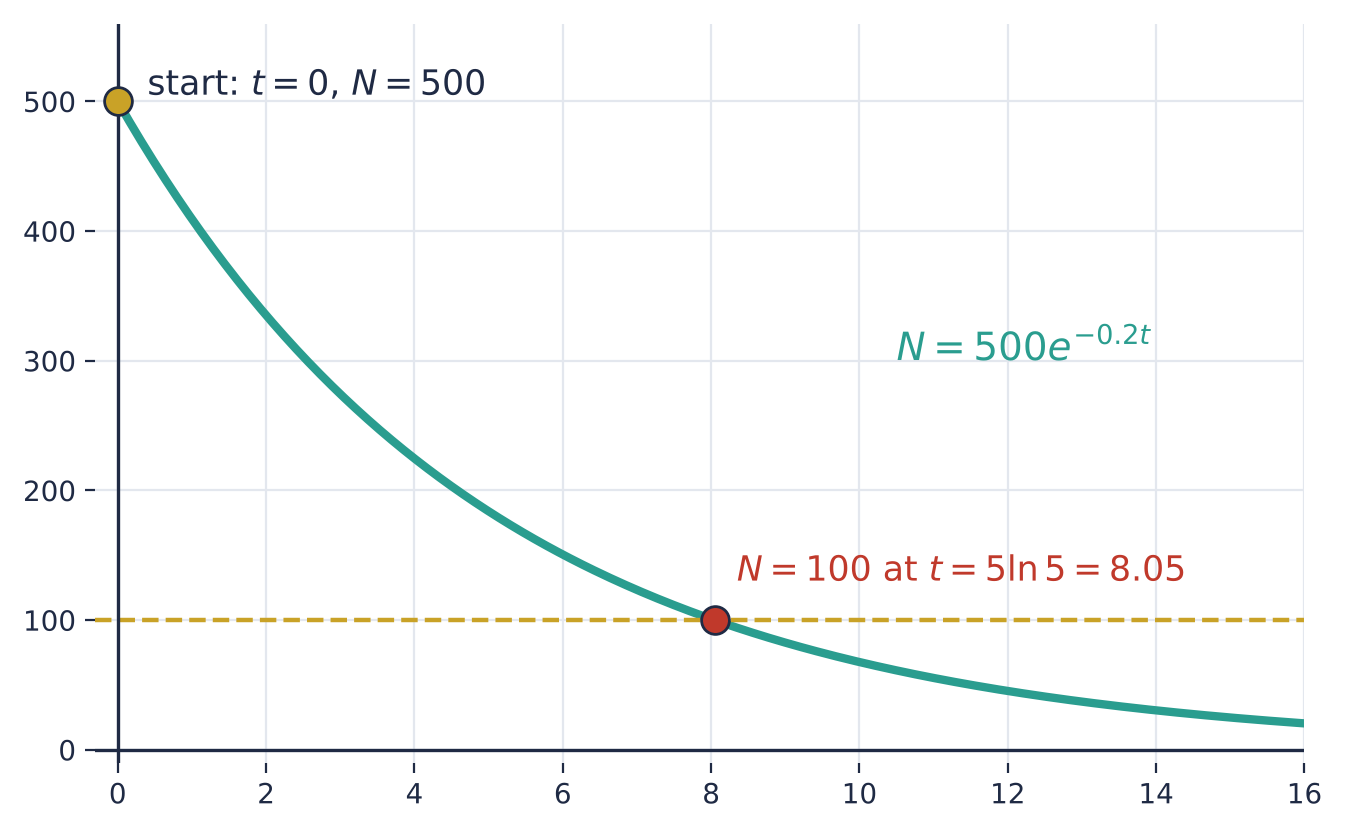
Decay: N = 500e^(−0.2t). Find t when N = 100
e.g.
- the start value: gives
- when : , which is (3 s.f.)
Worked example
The amount of a medicine, milligrams (mg), in a patient's blood hours (h) after an injection is given by . Find the amount of medicine in the blood after hours, giving your answer correct to 3 significant figures.
Step 1 of 2
Substitute t = 5
Free account
What you get when you sign in
Everything on this page stays free. An account is where exponential models practice starts adding up.
- Endless questions on every chapter, at every level
- Your mistakes tracked by type, so you see what keeps costing marks
- Revision reminders before a topic fades
Start freeFree account. No card. Takes a minute.
Compare browsing and a free account
| Browsing | Account | |
|---|---|---|
| Read the notes and print worksheets and papers | ✓ | ✓ |
| Try a question with marking, hints and the step guide | ✓ | ✓ |
| Endless questions on every chapter, at every level | – | ✓ |
| Levels that unlock as you improve | – | ✓ |
| Your mistakes tracked by type, so you see what keeps costing marks | – | ✓ |
| WA practice papers on the chapters being tested | – | ✓ |
| Revision reminders before a topic fades | – | ✓ |
| Progress page and leaderboards | – | ✓ |
Questions
- Question 1The start and a later value
The temperature, degrees Celsius (°C), of a bottle of water minutes (min) after it is taken out of a fridge is given by . State the initial value of .
Show the worked solution
- Step 1: The initial value is the value at t = 0: substitute
- Step 2: e⁰ = 1
- Question 2Find the time
The amount of a medicine, milligrams (mg), in a patient's blood hours (h) after an injection is given by . Find the time, in hours, for the amount of medicine in the blood to fall to mg, giving your answer correct to 3 significant figures.
Show the worked solution
- Step 1: Put D = 12
- Step 2: Divide both sides by 32
- Step 3: Take ln of both sides: ln and e undo each other
- Step 4: Divide both sides by −0.3, then round to 3 significant figures
- Question 3Find the constant k
The number of bacteria, , in a dish hours (h) after the start of an experiment is given by , where is a positive constant. After hours, the number of bacteria is . Find the value of , giving your answer correct to 3 significant figures.
Show the worked solution
- Step 1: Put t = 4 and N = 242
- Step 2: Divide both sides by 150
- Step 3: Take ln of both sides: ln and e undo each other
- Step 4: Divide both sides by 4, then round to 3 significant figures
- Question 4The long run
The mass, grams (g), of a radioactive substance days after it is first measured is given by . State the value that approaches in the long run, as becomes very large.
Show the worked solution
- Step 1: As t becomes very large, what does e^(−0.05t) approach?As , .
- Step 2: So m gets close to 0