Loading…
Sec 3 A-Math · Trigonometric functions and graphs
Amplitude, period, maximum and minimum questions with answers
Practice questions on amplitude, period, maximum and minimum, from the basics up to exam level, each with a full worked solution. Try one online now, or work through the list below on paper and open the solution to check your working.
Try a question: Amplitude, period, maximum and minimum
Free · no sign-upAnswer a real practice question. Get it wrong and MugCorner shows you where it went wrong, with hints and a step-by-step guide.
Key facts: Graphs of sine, cosine and tangent
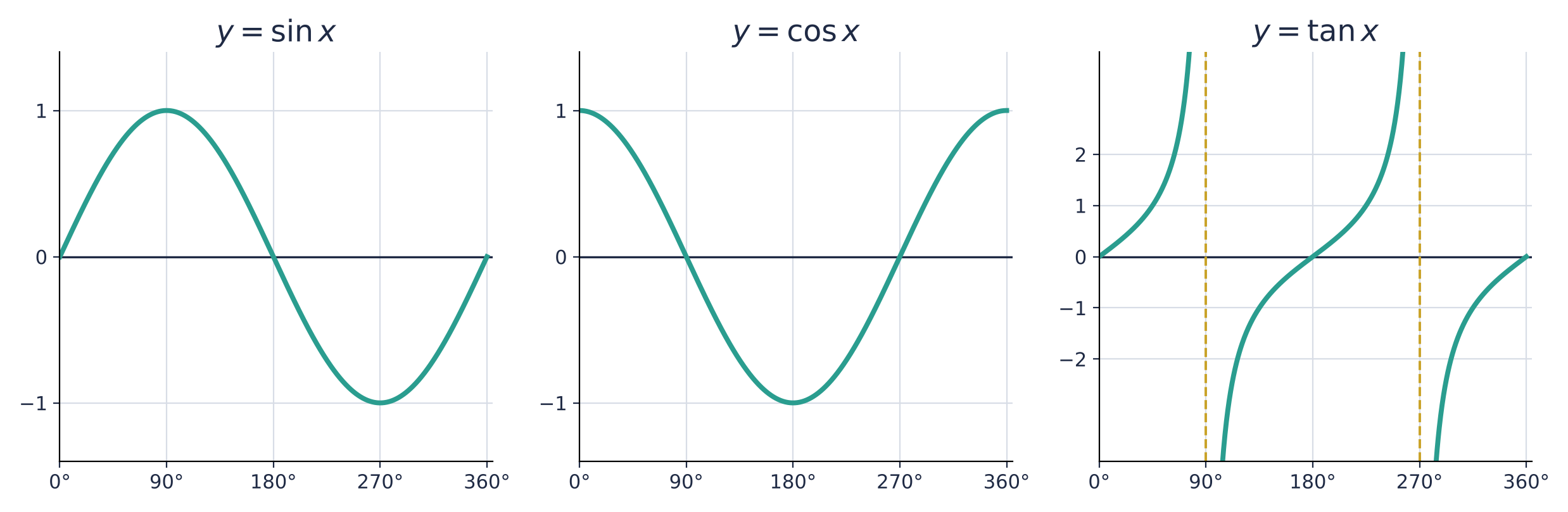
amplitude
- Formula
- the size of (its value without the sign)
period ()
- Formula
- or
maximum
- Formula
- amplitude
minimum
- Formula
- amplitude
: period
- Formula
- or
| or | Formula | |
|---|---|---|
| amplitude | the size of (its value without the sign) | |
| period () | or | |
| maximum | amplitude | |
| minimum | amplitude | |
| : period | or |
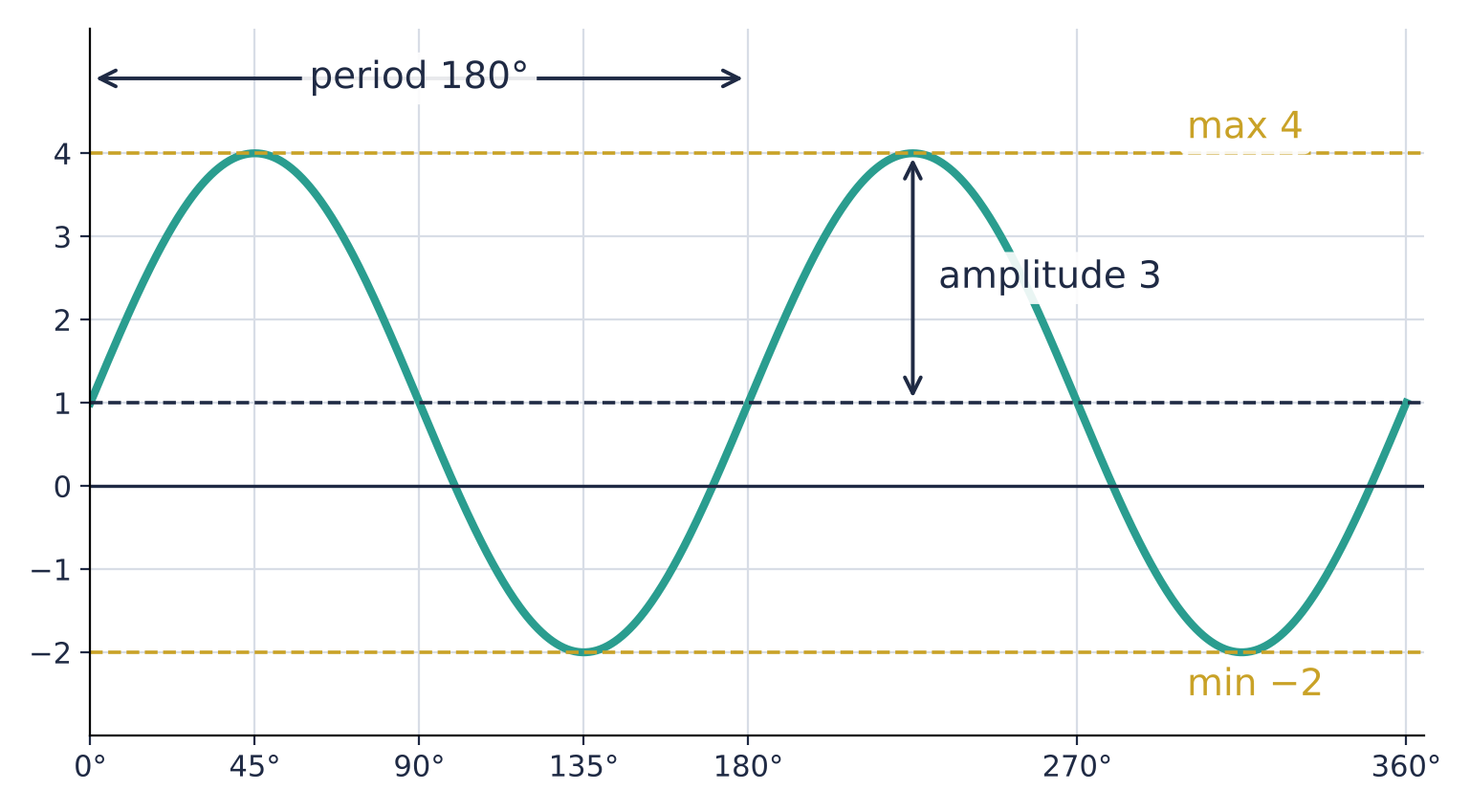
- What it does
- stretches up and down: the amplitude is the size of (its value without the sign). A negative flips the graph in its middle line
- Example
- goes down to first, then up
- What it does
- squeezes sideways: full waves in , so the period is
- Example
- : 3 full waves, period
- What it does
- moves up or down: the middle line is
- Example
- swings between and about
| What it does | Example | |
|---|---|---|
| stretches up and down: the amplitude is the size of (its value without the sign). A negative flips the graph in its middle line | goes down to first, then up | |
| squeezes sideways: full waves in , so the period is | : 3 full waves, period | |
| moves up or down: the middle line is | swings between and about |
Worked example
State the amplitude of .
Step 1 of 1
Amplitude = the size of a (its value without the sign): the number in front
Free account
What you get when you sign in
Everything on this page stays free. An account is where amplitude, period, maximum and minimum practice starts adding up.
- Endless questions on every chapter, at every level
- Your mistakes tracked by type, so you see what keeps costing marks
- Revision reminders before a topic fades
Start freeFree account. No card. Takes a minute.
Compare browsing and a free account
| Browsing | Account | |
|---|---|---|
| Read the notes and print worksheets and papers | ✓ | ✓ |
| Try a question with marking, hints and the step guide | ✓ | ✓ |
| Endless questions on every chapter, at every level | – | ✓ |
| Levels that unlock as you improve | – | ✓ |
| Your mistakes tracked by type, so you see what keeps costing marks | – | ✓ |
| WA practice papers on the chapters being tested | – | ✓ |
| Revision reminders before a topic fades | – | ✓ |
| Progress page and leaderboards | – | ✓ |
Questions
- Question 1Amplitude
State the amplitude of .
Show the worked solution
- Step 1: Amplitude = the size of a (its value without the sign): the number in front
- Question 2Period
State the period, in degrees, of .
Show the worked solution
- Step 1: Period = the period of tan x (180°) ÷ b
- Question 3Maximum and minimum values
State the maximum value of .
Show the worked solution
- Step 1: cos goes between −1 and 1
- Step 2: Maximum = c + amplitude (when the ratio is at its top)
- Question 4Which graph? Pick the graph for an equation
Which graph, A, B, C or D, shows for ?
A B C D Show the worked solution
- Step 1: Amplitude = the size of a (its value without the sign): how far the graph goes above and below its middle line
- Step 2: Period = 360° ÷ b: the width of one full wave
- Step 3: The middle line is y = c
- Step 4: Where does the graph start at x = 0, and which way does it go? (A negative a turns sin upside down.)At the graph starts on the middle line going up.
- Step 5: AnswerGraph : amplitude 3, period 180°, middle line y = 1, starting at a maximum.Graph : amplitude 3, period 180°, middle line y = 1, starting on the middle line going up: this one.Graph : amplitude 3, period 180°, middle line y = 1, starting on the middle line going down.Graph : amplitude 3, period 180°, middle line y = −1, starting on the middle line going up.
- Question 5Find a, b and c from the graph
The graph shows for , where . Find the values of , and .
Show the worked solution
- Step 1: Read the highest and lowest values off the graph
- Step 2: c is the middle line: halfway between them
- Step 3: The amplitude is half the height of the wave
- Step 4: At x = 0, does it start the usual way, or upside down?It starts at a maximum, so is positive: .
- Step 5: Read the period: the width of one full wave. Then b = 360° ÷ period
- Question 6A maximum or minimum point
Find the coordinates of the maximum point of the curve for .
Show the worked solution
- Step 1: y is greatest when sin 2x is is negative, so is greatest when .
- Step 2: So the greatest value of y
- Step 3: Where is sin equal to -1? Then x, in the range
- Step 4: The point
- Question 7How many solutions? Draw a line
The diagram shows the graph of for . By drawing a suitable straight line, state the number of solutions of the equation for .
Show the worked solution
- Step 1: Make the left-hand side the graph's equation: it already is (the graph has no number added)
- Step 2: So draw the horizontal line
- Step 3: Count the points where the line meets the curve (a line touching the top or bottom of a wave meets it once there)
- Question 8Period in radians, and x over b
State the period, in degrees, of .
Show the worked solution
- Step 1: The period of y = sin x: 180° or 360°?The period of is .
- Step 2: x over 3 is 1/3 of x: b is a fraction (not the number in front)
- Step 3: Period = the period of sin x (360°) ÷ b: dividing by 1/3 is multiplying by 3
- Question 9The range of k
Find the range of values of for which the equation has no solutions for .
Show the worked solution
- Step 1: sin x goes from −1 to 1, so the curve goes from c − amplitude to c + amplitude
- Step 2: The line y = k meets the curve unless it is above the top or below the bottom. No solutions whenThere are no solutions when the line is below the minimum or above the maximum.
- Step 3: Write the range of k
- Question 10Graphs of sin, cos and tan: key points and symmetry
Find the other value of , for , for which .
Show the worked solution
- Step 1: tan repeats every 180°: tan(x + 180°) = tan x. Add 180°, or take it away if that would go past 360°
- Step 2: Work it out