Loading…
Sec 1 Maths · Angles and parallel lines
Angles and parallel lines questions with answers
Practice questions on angles and parallel lines, from the basics up to exam level, each with a full worked solution. Try one online now, or work through the list below on paper and open the solution to check your working.
Try a question: Angles and parallel lines
Free · no sign-upAnswer a real practice question. Get it wrong and MugCorner shows you where it went wrong, with hints and a step-by-step guide.
Key facts: Parallel lines
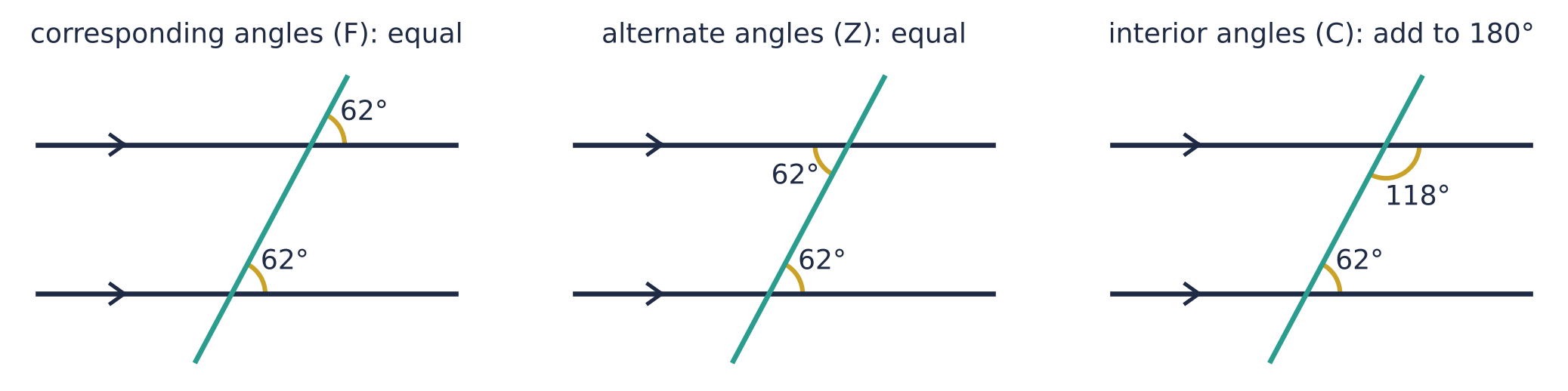
corresponding
- Shape
- F
- Rule
- equal
- Reason to write
- corr. s,
alternate
- Shape
- Z
- Rule
- equal
- Reason to write
- alt. s,
interior
- Shape
- C
- Rule
- add up to
- Reason to write
- int. s,
| Angles | Shape | Rule | Reason to write |
|---|---|---|---|
| corresponding | F | equal | corr. s, |
| alternate | Z | equal | alt. s, |
| interior | C | add up to | int. s, |
a bend with a reflex angle
- Use
- line through the bend parallel to both: inside angle sum of the two alternate angles; reflex angle inside angle
a triangle between parallel lines
- Use
- alternate angles give its angles; equal angles face equal sides; the longest side faces the largest angle
| Figure | Use |
|---|---|
| a bend with a reflex angle | line through the bend parallel to both: inside angle sum of the two alternate angles; reflex angle inside angle |
| a triangle between parallel lines | alternate angles give its angles; equal angles face equal sides; the longest side faces the largest angle |
Worked example
In the diagram, is parallel to , and the straight line cuts them at and . Find .
Step 1 of 1
Find x and give the reason
(alt. ∠s, )
Free account
What you get when you sign in
Everything on this page stays free. An account is where angles and parallel lines practice starts adding up.
- Endless questions on every chapter, at every level
- Your mistakes tracked by type, so you see what keeps costing marks
- Revision reminders before a topic fades
Start freeFree account. No card. Takes a minute.
Compare browsing and a free account
| Browsing | Account | |
|---|---|---|
| Read the notes and print worksheets and papers | ✓ | ✓ |
| Try a question with marking, hints and the step guide | ✓ | ✓ |
| Endless questions on every chapter, at every level | – | ✓ |
| Levels that unlock as you improve | – | ✓ |
| Your mistakes tracked by type, so you see what keeps costing marks | – | ✓ |
| WA practice papers on the chapters being tested | – | ✓ |
| Revision reminders before a topic fades | – | ✓ |
| Progress page and leaderboards | – | ✓ |
Questions
- Question 1Parallel lines: equal angles, and which reason
In the diagram, is parallel to , and the straight line cuts them at and . Find .
Diagram not drawn to scale Show the worked solution
- Step 1: Find x and give the reason (alt. ∠s, )
- Question 2Parallel lines: equal, or adding up to 180°?
In the diagram, is parallel to , and the straight line cuts them at and . Find .
Diagram not drawn to scale Show the worked solution
- Step 1: Find x and give the reason (corr. ∠s, )
- Question 3Parallel lines: any pair, with its reason
In the diagram, is parallel to , and the straight line cuts them at and . Find .
Diagram not drawn to scale Show the worked solution
- Step 1: Which angle fact links x° and the given angle? (int. ∠s, )
- Step 2: Find x
- Question 4Two steps with a transversal
In the diagram, is parallel to , and the straight line cuts them at and . Find .
Diagram not drawn to scale Show the worked solution
- Step 1: First find the angle at Q that corresponds to the given angle (corr. ∠s, )
- Step 2: Then use it to find x (∠s on a str. line)
- Question 5Parallel lines with expressions
In the diagram, is parallel to , and the straight line cuts them at and . Find .
Diagram not drawn to scale Show the worked solution
- Step 1: Write an equation in x (int. ∠s, )
- Step 2: Collect like terms and solve, so the angle is ., so the angle is .
- Question 6A bend between parallel lines (construction line)
In the diagram, is parallel to . Find .
Diagram not drawn to scale Show the worked solution
- Step 1: Draw a line through E parallel to AB and CDDraw the line through , parallel to and , pointing towards and . It splits into and .
- Step 2: The part next to AB (int. ∠s, )
- Step 3: The part next to CD (int. ∠s, )
- Step 4: Add the two parts
- Question 7A bend with a reflex angle as an expression
In the diagram, is parallel to . The reflex angle is . Find .
Diagram not drawn to scale Show the worked solution
- Step 1: Draw a line through E parallel to AB and CDDraw the line through , parallel to and , pointing towards and . It splits the angle inside the bend into and .
- Step 2: The part next to AB (alt. ∠s, )
- Step 3: The part next to CD (alt. ∠s, )
- Step 4: The reflex angle and the two parts go all the way round E (∠s at a pt.)
- Step 5: Collect like terms and solve
- Question 8Isosceles triangles and the longest side
In the diagram, is parallel to . Which side of triangle is the longest? Choose the answer.
Diagram not drawn to scale Show the worked solution
- Step 1: Find ∠PQS (alt. ∠s, )
- Step 2: Find ∠PSQ (alt. ∠s, )
- Step 3: Find ∠QPS (∠s on a str. line)
- Step 4: The longest side is opposite the largest angleThe largest angle is , at , so the longest side is , opposite it.