Loading…
IGCSE Mathematics (0580) · Extended
Similarity
Practise similarity with step-by-step help. Free account.
1. Similar triangles
- Meaning
- similar: same shape, sides in the same ratio
- Example
ratio
- Meaning
- matching sides divide to the same number
- Example
| Symbol | Meaning | Example |
|---|---|---|
| similar: same shape, sides in the same ratio | ||
| ratio | matching sides divide to the same number |
AA
- Shown by
- two pairs of equal angles
SSS
- Shown by
- three pairs of sides in the same ratio
SAS
- Shown by
- two pairs of sides in the same ratio, the angle between them equal
| Test | Shown by |
|---|---|
| AA | two pairs of equal angles |
| SSS | three pairs of sides in the same ratio |
| SAS | two pairs of sides in the same ratio, the angle between them equal |
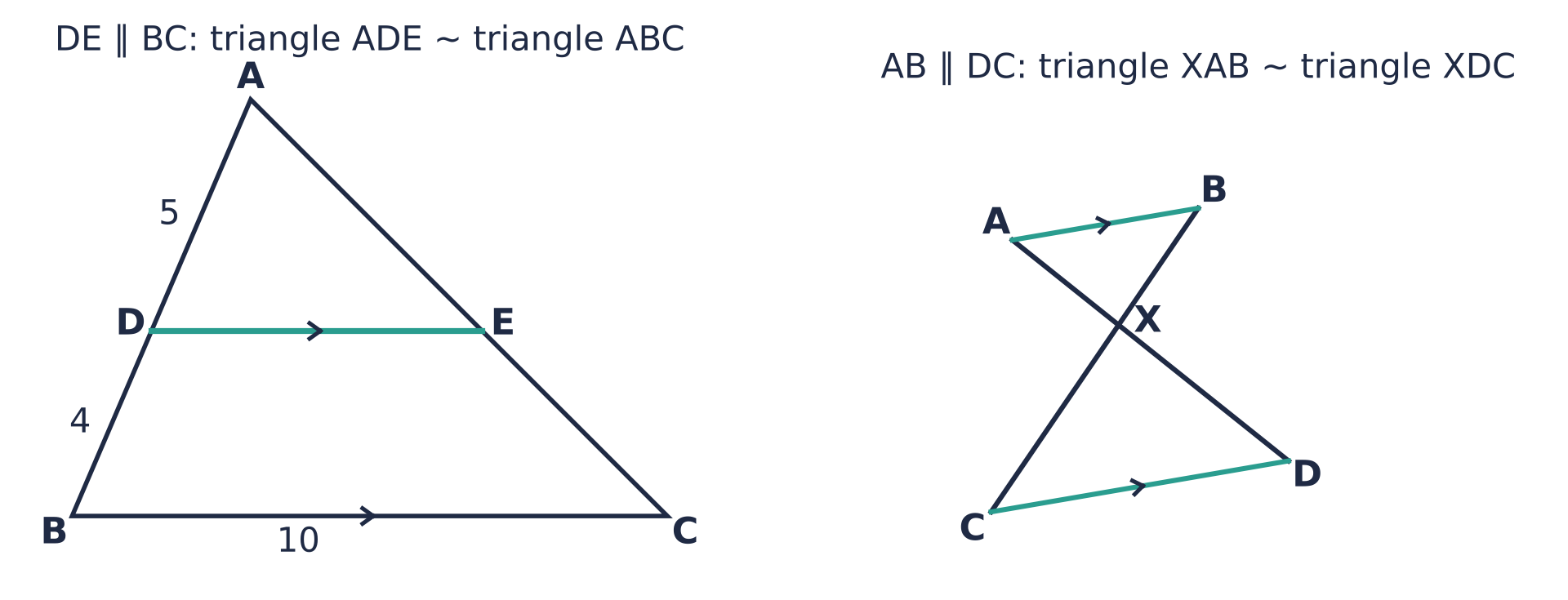
DE ∥ BC: use the whole side AB = 5 + 4
e.g.
AB ∥ DC, crossing at X: AX = 5, XD = 8, AB = 7
e.g.
📖 Worked example
In the diagram, lies on and lies on , with parallel to . Find , correct to 3 significant figures.
The figure fills in as you go through the steps: teal is what this step finds.
Step 1 of 3
DE ∥ BC, so triangle ADE is similar to triangle ABC
corresponding angles
is common, so the triangles are similar (AA).
📖 Worked example
In the diagram, the lines and meet at , and is parallel to . Find .
The figure fills in as you go through the steps: teal is what this step finds.
Step 1 of 2
AB ∥ DC, so triangle XAB is similar to triangle XDC
alternate angles
vertically opposite angles
Your turn
Try one like these, checked as you answer, with hints if you need them. Free, no sign-up.
2. Area ratio
lengths
- Formula
- Example: lengths
areas
- Formula
- Example: lengths
volumes
- Formula
- Example: lengths
masses (same material)
- Formula
- Example: lengths
| Ratio | Formula | Example: lengths |
|---|---|---|
| lengths | ||
| areas | ||
| volumes | ||
| masses (same material) |
Area from lengths: 6 cm and 9 cm, larger area 36 cm²
e.g.
Length from areas: 8 cm² and 15.68 cm², larger side 7 cm, find the smaller side l
e.g.
Areas on a map: square the scale
- cm² km²
- cm² km²
📖 Worked example
Triangles and are similar, with areas cm² and cm² respectively. cm. Find .
The figure fills in as you go through the steps: teal is what this step finds.
Step 1 of 3
How are the lengths related to the areas?
📖 Worked example
A map is drawn to a scale of . A park has an area of cm² on the map. Find the actual area, in km², of the park.
Step 1 of 3
Write the scale as a ratio with units (1 km = 100 000 cm)
Your turn
Try one like these, checked as you answer, with hints if you need them. Free, no sign-up.
3. Volume and mass ratio
Volume from lengths: heights 5 cm and 6 cm, smaller 80 cm³
e.g.
Length from volumes: 189 cm³ and 448 cm³, smaller height 6 cm
e.g.
Mass: same material, heights 4 cm and 6 cm, smaller 108 g
e.g.
length
- Real object
- Units
- m cm
area
- Real object
- Units
- m² cm²
volume
- Real object
- Units
- m³ cm³
| Model at | Real object | Units |
|---|---|---|
| length | m cm | |
| area | m² cm² | |
| volume | m³ cm³ |
📖 Worked example
A model of a building is made to a scale of . The volume of the model is cm³. Find the volume, in m³, of the real building.
Step 1 of 2
Volumes: the ratio of lengths cubed
Volume ratio
📖 Worked example
Two similar cylinders have volumes cm³ and cm³. The height of the smaller cylinder is cm. Find the height of the larger cylinder.
The figure fills in as you go through the steps: teal is what this step finds.
Step 1 of 3
Lengths are in the ratio of the cube roots of the volumes
More worked examples (1)
📖 Worked example
An inverted cone of height cm has a capacity of cm³. It contains cm³ of water. Find the depth of the water.
The figure fills in as you go through the steps: teal is what this step finds.
Step 1 of 3
The water forms a cone similar to the whole cone
Your turn
Try one like these, checked as you answer, with hints if you need them. Free, no sign-up.
Free account
What you get when you sign in
Everything on this page stays free. An account is where similarity practice starts adding up.
- Endless questions on every chapter, at every level
- Your mistakes tracked by type, so you see what keeps costing marks
- Revision reminders before a topic fades
Start freeFree account. No card. Takes a minute.
Compare browsing and a free account
| Browsing | Account | |
|---|---|---|
| Read the notes and print worksheets and papers | ✓ | ✓ |
| Try a question with marking, hints and the step guide | ✓ | ✓ |
| Endless questions on every chapter, at every level | – | ✓ |
| Levels that unlock as you improve | – | ✓ |
| Your mistakes tracked by type, so you see what keeps costing marks | – | ✓ |
| WA practice papers on the chapters being tested | – | ✓ |
| Revision reminders before a topic fades | – | ✓ |
| Progress page and leaderboards | – | ✓ |