Loading…
IB Analysis and approaches · SL and HL
Probability
Practise probability with step-by-step help. Free account.
1. Probability of an event
probability
- Formula
range
- Formula
not happening
- Formula
- , where means does not happen
| Rule | Formula |
|---|---|
| probability | |
| range | |
| not happening | , where means does not happen |
2 red, 7 blue, 3 green: P(blue)
- total: , which is
P(not blue)
e.g.
6 red balls and P(red) known: the total n
e.g.
- blue balls: , which is
📖 Worked example
Cards numbered to are shuffled and one is drawn at random. Find the probability that the number is a prime number.
Step 1 of 2
List the numbers from 1 to 15 that are a prime number: test each in turn
That is numbers out of .
📖 Worked example
A bag contains red balls and blue balls. red balls and blue balls are put into the bag. A ball is then taken at random. The probability that it is red is . Find the value of .
Step 1 of 4
After the change: the number of red balls, and the number of all the balls, in terms of x
Red balls
All the balls
More worked examples (1)
📖 Worked example
The two-way table shows the students in a class. A student is chosen at random. Find the probability that the student is a boy who wears glasses.
| Wear glasses | Do not wear glasses | Total | |
|---|---|---|---|
| Boys | 12 | 8 | 20 |
| Girls | 9 | 11 | 20 |
| Total | 21 | 19 | 40 |
Step 1 of 3
Count the boys who wears glasses
From the table
Your turn
Try one like these, checked as you answer, with hints if you need them. Free, no sign-up.
2. Possibility diagrams
🎛️ Explore: two dice
| + | 1 | 2 | 3 | 4 | 5 | 6 |
|---|---|---|---|---|---|---|
| 1 | 2 | 3 | 4 | 5 | 6 | 7 |
| 2 | 3 | 4 | 5 | 6 | 7 | 8 |
| 3 | 4 | 5 | 6 | 7 | 8 | 9 |
| 4 | 5 | 6 | 7 | 8 | 9 | 10 |
| 5 | 6 | 7 | 8 | 9 | 10 | 11 |
| 6 | 7 | 8 | 9 | 10 | 11 | 12 |
(10 of the 36 outcomes)
- Every square is one outcome, and all 36 are equally likely: count the squares, then divide by 36.
- (3, 6) and (6, 3) are different squares: the first die and the second die.
Two dice: P(sum > 8), the 10 bold outcomes out of 36
e.g.
📖 Worked example
Spinner A has the numbers and spinner B has . Both are spun. Using a possibility diagram, find the probability that the sum of the two numbers is greater than .
| + | 0 | 1 | 2 | 3 | 4 |
|---|---|---|---|---|---|
| 1 | |||||
| 2 | |||||
| 3 |
Step 1 of 3
Fill in the possibility diagram
There are equally likely outcomes.
📖 Worked example
Two fair dice are thrown. The possibility diagram shows the sum of the two scores. Ring every outcome where the sum of the two scores is greater than .
| + | 1 | 2 | 3 | 4 | 5 | 6 |
|---|---|---|---|---|---|---|
| 1 | 2 | 3 | 4 | 5 | 6 | 7 |
| 2 | 3 | 4 | 5 | 6 | 7 | 8 |
| 3 | 4 | 5 | 6 | 7 | 8 | 9 |
| 4 | 5 | 6 | 7 | 8 | 9 | [10] |
| 5 | 6 | 7 | 8 | 9 | [10] | [11] |
| 6 | 7 | 8 | 9 | [10] | [11] | [12] |
Step 1 of 3
Read the rule: which values count?
Look at the number in each cell. It is ringed when the sum of the two scores is greater than .
Your turn
Try one like these, checked as you answer, with hints if you need them. Free, no sign-up.
3. Tree diagrams
along a branch: multiply
- Example: 2 red, 5 blue, without replacement
- , which is
between branches: add
- Example: 2 red, 5 blue, without replacement
each pair of branches adds up to
- Example: 2 red, 5 blue, without replacement
| Rule | Example: 2 red, 5 blue, without replacement |
|---|---|
| along a branch: multiply | , which is |
| between branches: add | |
| each pair of branches adds up to |
With replacement: the second draw is the same
e.g.
Without replacement: one fewer ball
e.g.
📖 Worked example
A bag contains red and blue balls. Two balls are taken at random, one after the other, without replacement. The tree diagram shows the outcomes. Find the probability that both balls are blue.
Step 1 of 2
Read the probability on each branch of the tree
First: , .
After a red: , .
After a blue: , .
📖 Worked example
A bag contains red and blue balls. Two balls are taken at random, one after the other, without replacement. Draw a tree diagram to show the outcomes. Hence find the probability that one ball of each colour is taken.
Step 1 of 3
Complete the tree: the first ball, then the second ball after each colour
An unknown number n of red balls (with 3 blue): P(both red) known
e.g.
- ; reject (a number of balls)
More worked examples (2)
📖 Worked example
A bag contains red balls and blue balls. Two balls are taken at random, one after the other, without replacement. The probability that both balls are red is . Find the total number of balls in the bag.
Step 1 of 4
Multiply along the branch for this outcome: write the equation
one red fewer and one ball fewer for the second ball
📖 Worked example
A bag contains red balls and blue balls. Three balls are taken at random, one after the other, without replacement. The probability that all three balls are red is . Show that , and hence find the number of red balls in the bag.
Step 1 of 4
Multiply along the branch for this outcome: write the equation
one red fewer and one ball fewer each time
Your turn
Try one like these, checked as you answer, with hints if you need them. Free, no sign-up.
4. Mutually exclusive and independent events
mutually exclusive
- Meaning
- cannot both happen
- Rule
independent
- Meaning
- one does not change the other
- Rule
at least one
- Meaning
- one or more: everything except none
- Rule
| Events | Meaning | Rule |
|---|---|---|
| mutually exclusive | cannot both happen | |
| independent | one does not change the other | |
| at least one | one or more: everything except none |
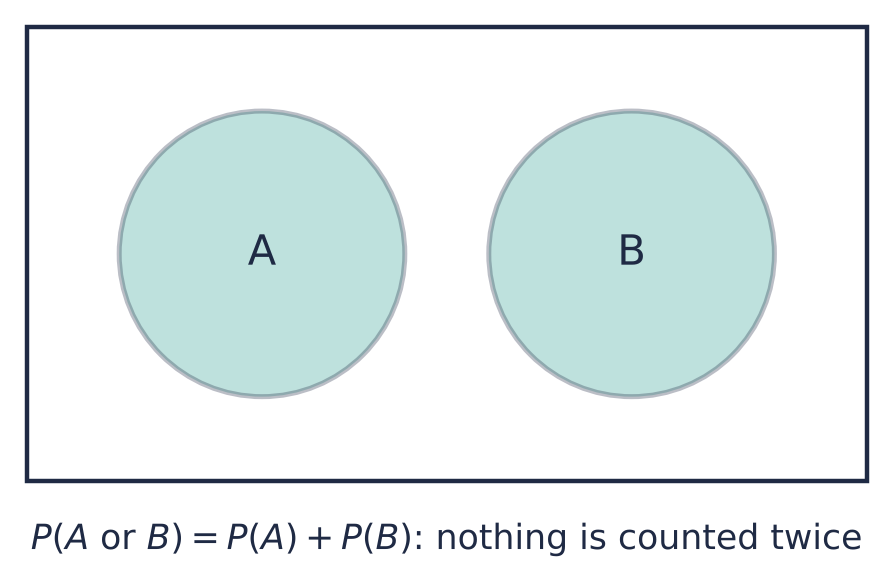
Mutually exclusive: neither A nor B
e.g.
Independent, P(A) = 0.7 and P(B) = 0.4: A but not B
e.g.
Independent: at least one
e.g.
📖 Worked example
and are mutually exclusive events with and . Find the probability that neither nor occurs.
Step 1 of 2
P(A or B) for mutually exclusive events
📖 Worked example
The probability that it rains tomorrow is and the probability that the bus is late is . The two events are independent. Find the probability that at least one of the two events occurs.
Step 1 of 3
The probability that each event does not occur
Your turn
Try one like these, checked as you answer, with hints if you need them. Free, no sign-up.
5. Relative and expected frequency
Relative frequency
e.g.
Expected frequency
e.g.
📖 Worked example
Ali spun a spinner times. The table shows his results. Find the relative frequency of blue.
| Outcome | Red | Blue | Green | Yellow |
|---|---|---|---|---|
| Frequency | 2 | 8 | 7 | 3 |
Step 1 of 1
Relative frequency = the number of times it happened ÷ the number of trials
📖 Worked example
Ali spun a spinner times. The table shows his results. He spun it more times. Use his results to estimate how many of these give blue.
| Outcome | Red | Blue | Green | Yellow |
|---|---|---|---|---|
| Frequency | 2 | 8 | 7 | 3 |
Step 1 of 2
The relative frequency is the best estimate of the probability
More worked examples (1)
📖 Worked example
Ali spun a spinner times. The table shows his results. Is the spinner fair or biased?
| Outcome | Red | Blue | Green | Yellow |
|---|---|---|---|---|
| Frequency | 51 | 63 | 133 | 53 |
Step 1 of 2
If it were fair, each outcome would have probability 1/4
Your turn
Try one like these, checked as you answer, with hints if you need them. Free, no sign-up.
6. Conditional probability
Given B: count only inside B
- play tennis, of them also football:
📖 Worked example
The table shows how some students travel to school. One of the students is chosen at random. Given that they are a boy, find the probability that they come by car.
| Walk | Bus | Car | |
|---|---|---|---|
| Boys | 17 | 11 | 6 |
| Girls | 16 | 13 | 4 |
Step 1 of 3
"Given that": only those in the row Boys count. How many is that?
📖 Worked example
The Venn diagram shows the number of students in a group who play football (F) and who play tennis (T). One is chosen at random. Given that the person plays tennis, find the probability that they play football.
Step 1 of 3
"Given that": only the people inside T count. Add up those regions
More worked examples (1)
📖 Worked example
A bag contains red and blue balls. Two balls are taken at random without replacement. Given that the two balls are the same colour, find the probability that they are both red.
Step 1 of 3
P(both red): multiply along the branches
Your turn
Try one like these, checked as you answer, with hints if you need them. Free, no sign-up.
7. The rules
not A
- Rule
- Example
A or B
- Rule
- Example
mutually exclusive
- Rule
- Example
- a 1 and a 6 on one throw
A given B
- Rule
- Example
independent
- Rule
- Example
B but not A
- Rule
- Example
| Name | Rule | Example |
|---|---|---|
| not A | ||
| A or B | ||
| mutually exclusive | a 1 and a 6 on one throw | |
| A given B | ||
| independent | ||
| B but not A |
📖 Worked example
For two events and , and , and . Find .
Step 1 of 1
Given B: the part of B that is also A
Your turn
Try one like these, checked as you answer, with hints if you need them. Free, no sign-up.
8. Bayes' theorem
Total probability
e.g.
Bayes' theorem
e.g.
📖 Worked example
A factory makes bolts on two machines. of the bolts are made on machine A and of the bolts are made on machine B. of the bolts made on machine A are faulty and of the bolts made on machine B are faulty. A bolt is chosen at random and it is faulty. Find the probability that it was made on machine A.
Step 1 of 2
The probability of faulty: add the faulty branch of each cause
P(faulty)
📖 Worked example
A shop buys its light bulbs from three suppliers. of the bulbs come from supplier P, of the bulbs come from supplier Q, and of the bulbs come from supplier R. of the bulbs from supplier P are defective, of the bulbs from supplier Q are defective and of the bulbs from supplier R are defective. A bulb is chosen at random and it is defective. Find the probability that it came from supplier P.
Step 1 of 2
The probability of defective: add the defective branch of each cause
P(defective)
Your turn
Try one like these, checked as you answer, with hints if you need them. Free, no sign-up.
Free account
What you get when you sign in
Everything on this page stays free. An account is where probability practice starts adding up.
- Endless questions on every chapter, at every level
- Your mistakes tracked by type, so you see what keeps costing marks
- Revision reminders before a topic fades
Start freeFree account. No card. Takes a minute.
Compare browsing and a free account
| Browsing | Account | |
|---|---|---|
| Read the notes and print worksheets and papers | ✓ | ✓ |
| Try a question with marking, hints and the step guide | ✓ | ✓ |
| Endless questions on every chapter, at every level | – | ✓ |
| Levels that unlock as you improve | – | ✓ |
| Your mistakes tracked by type, so you see what keeps costing marks | – | ✓ |
| WA practice papers on the chapters being tested | – | ✓ |
| Revision reminders before a topic fades | – | ✓ |
| Progress page and leaderboards | – | ✓ |