Loading…
Sec 2 · G1 (N(T))
Money matters
Practise money matters with step-by-step help. Free account.
1. Simple interest
| Symbol | Meaning | Example |
|---|---|---|
| principal: the amount deposited or borrowed | $ | |
| rate, in % per year (per annum) | ||
| time, in years | ||
| interest | $ |
Simple interest
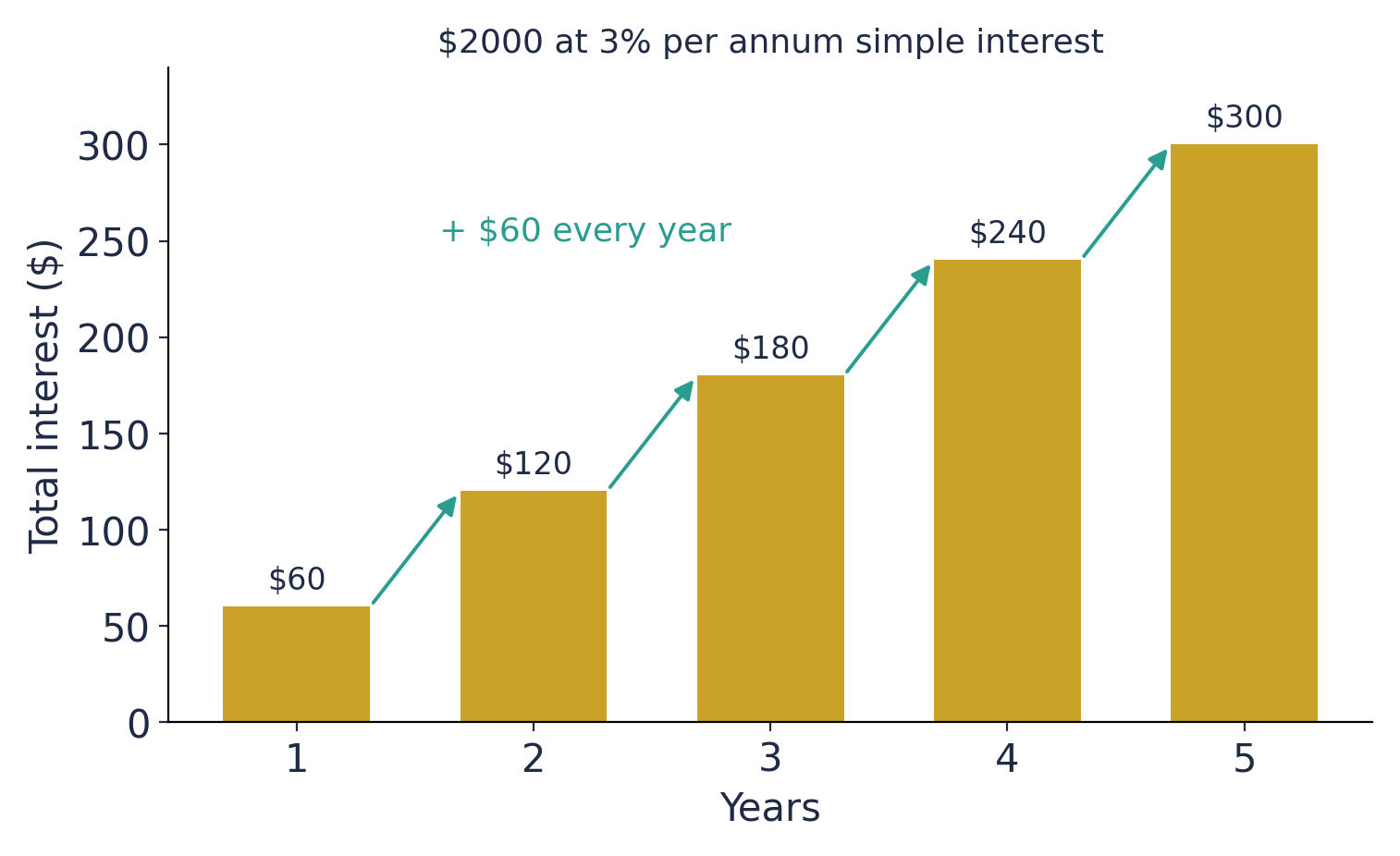
e.g.
Total amount: principal + interest
e.g.
Time in months: change to years first
e.g.
📖 Worked example
Chen Wei puts $1,000 in a fixed deposit account that pays 1.5% per annum simple interest. Find the total amount in the account after 4 years.
Step 1 of 2
Substitute P, R and T into the formula
📖 Worked example
Mei Ling deposits some money in a bank that pays simple interest of 2% per annum. After 5 years, the interest earned is $100. Find the amount of money Mei Ling deposited.
Step 1 of 2
Put the numbers you know into the formula
2. GST, service charge and discounts
| Charge | Multiply by | Example |
|---|---|---|
| service charge | , so $ | |
| GST | , so $ | |
| discount | , so $ |
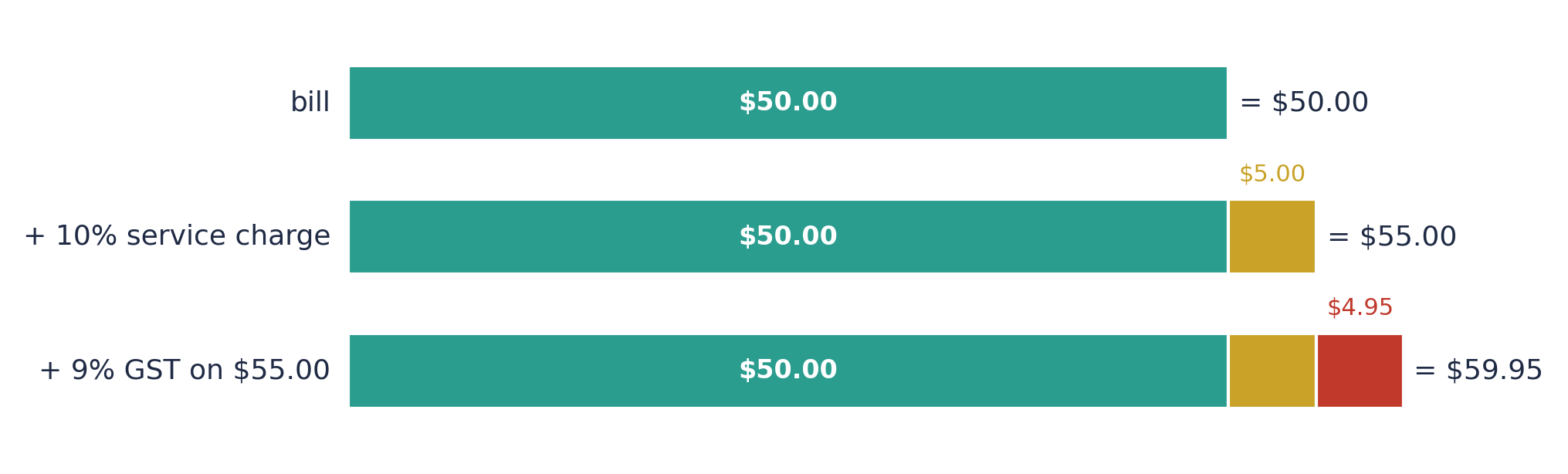
Restaurant bill: service charge first, then GST on that total
e.g.
Discount first, then GST
e.g.
Price before GST: the price with GST is 109%
e.g.
- the price before GST is $200
📖 Worked example
The table shows the food a family ordered at a restaurant. A 10% service charge is added to the bill, and then 9% GST is charged on the total. Find the amount the family pays, correct to the nearest cent.
| Item | Price |
|---|---|
| Fried rice | $8.50 |
| Iced lemon tea | $3.20 |
| Chilli crab | $48.00 |
Step 1 of 3
Add up the bill (in dollars)
📖 Worked example
The price of an air-conditioner, including 9% GST, is $446.90. Find its price before GST.
Step 1 of 3
The price with GST is what percentage of the price before GST? (in dollars)
📖 Worked example
The table shows the food a family ordered at a restaurant. Members get a 15% discount on the food, then a 10% service charge is added, and then 9% GST is charged on the total. The family are members. Find the amount they pay, correct to the nearest cent.
| Item | Price |
|---|---|
| Chicken rice | $7.60 |
| Tom yum soup | $11.80 |
| Roti prata set | $6.60 |
Step 1 of 4
Add up the food (in dollars)
3. Utilities and bills
| Bill | Charged for | How |
|---|---|---|
| electricity | kWh used | current reading previous reading, the rate |
| water | m³ used, in tiers | the first part at the lower rate, the rest at the higher rate |
| mobile phone | minutes over the free time | monthly fee extra minutes the rate |
Electricity: units used
e.g.
- at cents per kWh: is cents, which is $134.75
Water: 45 m³, the first 30 m³ at $1.20, the rest at $1.60
e.g.
📖 Worked example
The table shows a household's electricity meter readings for a month and the rate charged. Find the cost of the electricity used, in dollars.
| Previous meter reading | Current meter reading | Rate |
|---|---|---|
| 12460 kWh | 12828 kWh | 30 cents per kWh |
Step 1 of 3
Units used = current reading − previous reading
📖 Worked example
Mei Ling's mobile phone plan is shown in the table. In March, Mei Ling made 380 minutes of calls. Find the amount of Mei Ling's bill for March.
| Monthly fee | Free talk time | Extra calls |
|---|---|---|
| $20 | 300 min | 10 cents per min |
Step 1 of 3
Extra minutes = minutes used − free minutes
4. Currency exchange
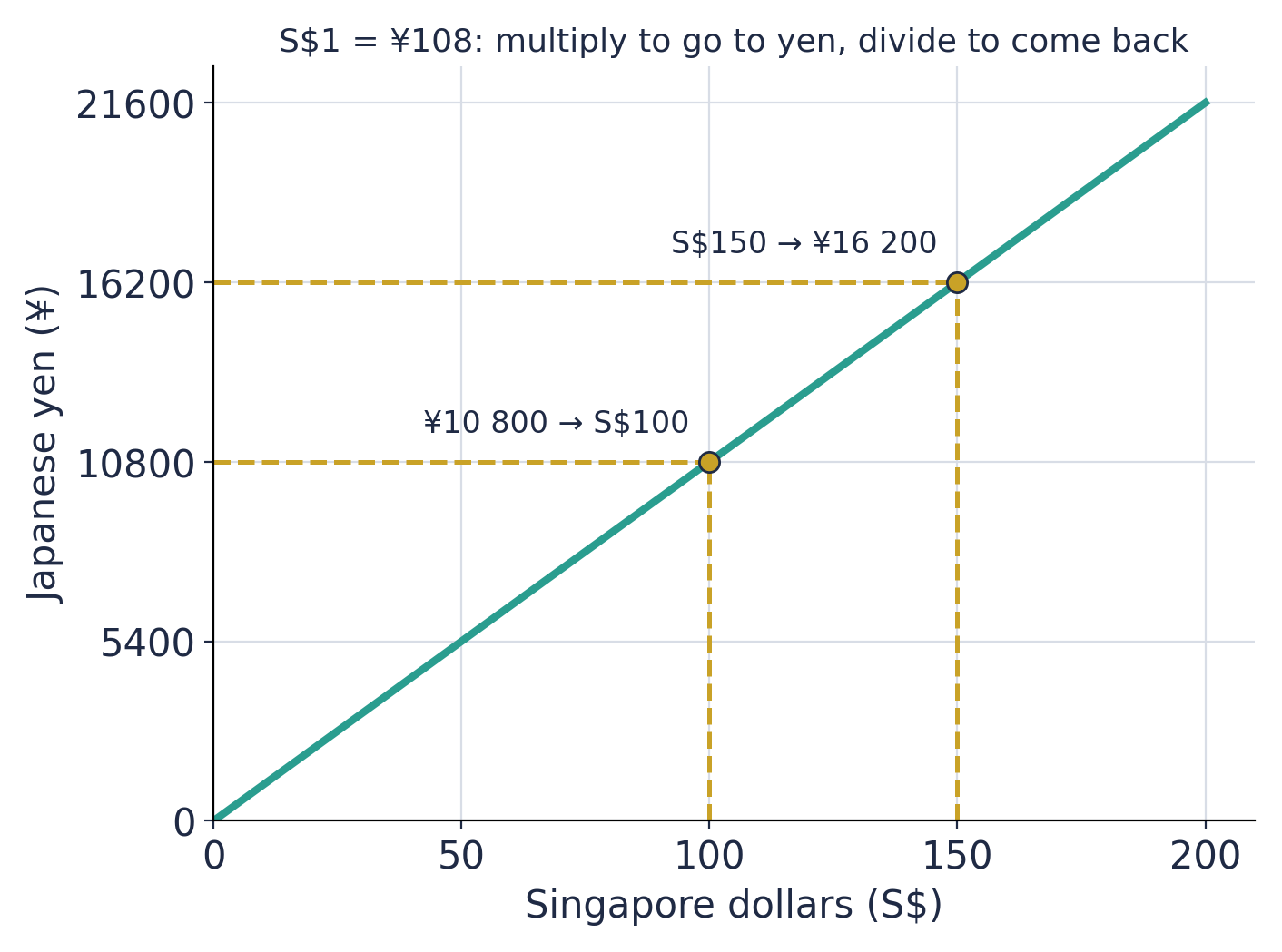
| Rate | S$ to the foreign currency | Back to S$ |
|---|---|---|
| S$1 buys ¥108 | multiply by | divide by |
| 1 ringgit costs S$0.30 | divide by | multiply by |
S$200 into yen
e.g.
- ¥
¥16 956 back into Singapore dollars
e.g.
- S$157
📖 Worked example
The table shows a money changer's exchange rates. Devi changes S$800 into Malaysian ringgit. Find the amount, in Malaysian ringgit, that Devi receives. Give your answer correct to 2 decimal places where necessary.
| Currency | S$1 buys |
|---|---|
| Malaysian ringgit (RM) | 3.4 |
| Japanese yen (¥) | 108 |
| Australian dollars (A$) | 1.2 |
Step 1 of 1
Use the exchange rate: multiply or divide?
Devi receives RM 2720.
📖 Worked example
Siti wants to change S$1000 into Malaysian ringgit. The rates at two money changers are shown in the table. Which money changer gives Siti more Malaysian ringgit?
| Money changer | Rate |
|---|---|
| A | S$1 = RM 3.4 |
| B | S$100 = RM 346.8 |
Step 1 of 3
Money changer A: the amount of Malaysian ringgit received
5. Instalments and hire purchase
| Term | Meaning | Example |
|---|---|---|
| cash price | the price paid all at once | $ |
| deposit | paid at the start | of : $ |
| loan (balance) | cash price deposit | $ |
| instalments | equal monthly payments | : $ |
| hire-purchase price | deposit all the instalments | $ |
Extra paid on hire purchase
e.g.
Monthly instalment: interest on the loan for the whole time, then share it out
e.g.
- per annum for months ( years): , so $180 interest
Interest as a percentage of the loan
e.g.
- of the loan
📖 Worked example
The table shows the terms for buying a home theatre system on hire purchase. Find how much more the home theatre system costs on hire purchase than for cash.
| Hire purchase | Home theatre system |
|---|---|
| Cash price | $1,200 |
| Deposit | 25% of the cash price |
| Monthly instalments | 30 instalments of $36 |
Step 1 of 4
Deposit (in dollars)
📖 Worked example
Hui Min buys a sofa set on the hire-purchase terms in the table. The balance after the deposit is charged simple interest for the 18 months, and the balance plus the interest is paid back in 18 equal monthly instalments. Find each monthly instalment.
| Hire purchase | Sofa set |
|---|---|
| Cash price | $960 |
| Deposit | 10% of the cash price |
| Interest on the balance | 5% per annum, simple interest |
| Repayment | 18 equal monthly instalments |
Step 1 of 5
Deposit (in dollars)
Practise money matters with step-by-step help
Endless questions from basic to exam level. Get one wrong and see where it went wrong. Free account.